Sunday, August 12, 2012

Part 35: Oslo is Hard to Navigate July 13-14, 2012

We got off the plane at Oslo Rygge airport and started looking into transport into town.  Budget airlines never fly into main airports.  You’re always way outside the city.  After comparing roundtrip shuttle costs with the train costs and checking on the return trip times, the bus won for overall cost and convenience.   A girl with a Canada flag on her backpack that had asked us about where to catch the bus ended up sitting behind us.  T was from Slovenia (though her mom is Canadian) and was in town for a veterinary conference.   She became our new Oslo friend. 

We got off the bus at the central bus station and began looking for the road to our hostel.  Europe really needs to embrace street signs on every corner.  The fact that you have to walk a few blocks at times just to discover what street you are on is really annoying.  After asking a security guard we headed off in the right direction.  However, he didn’t exactly send us to the road mentioned in the directions, so we asked a nice man on the street.  He knew exactly where we were going and we were there within 5 minutes.  T got a bed in the same room as us and then we headed out to do a little exploring. 
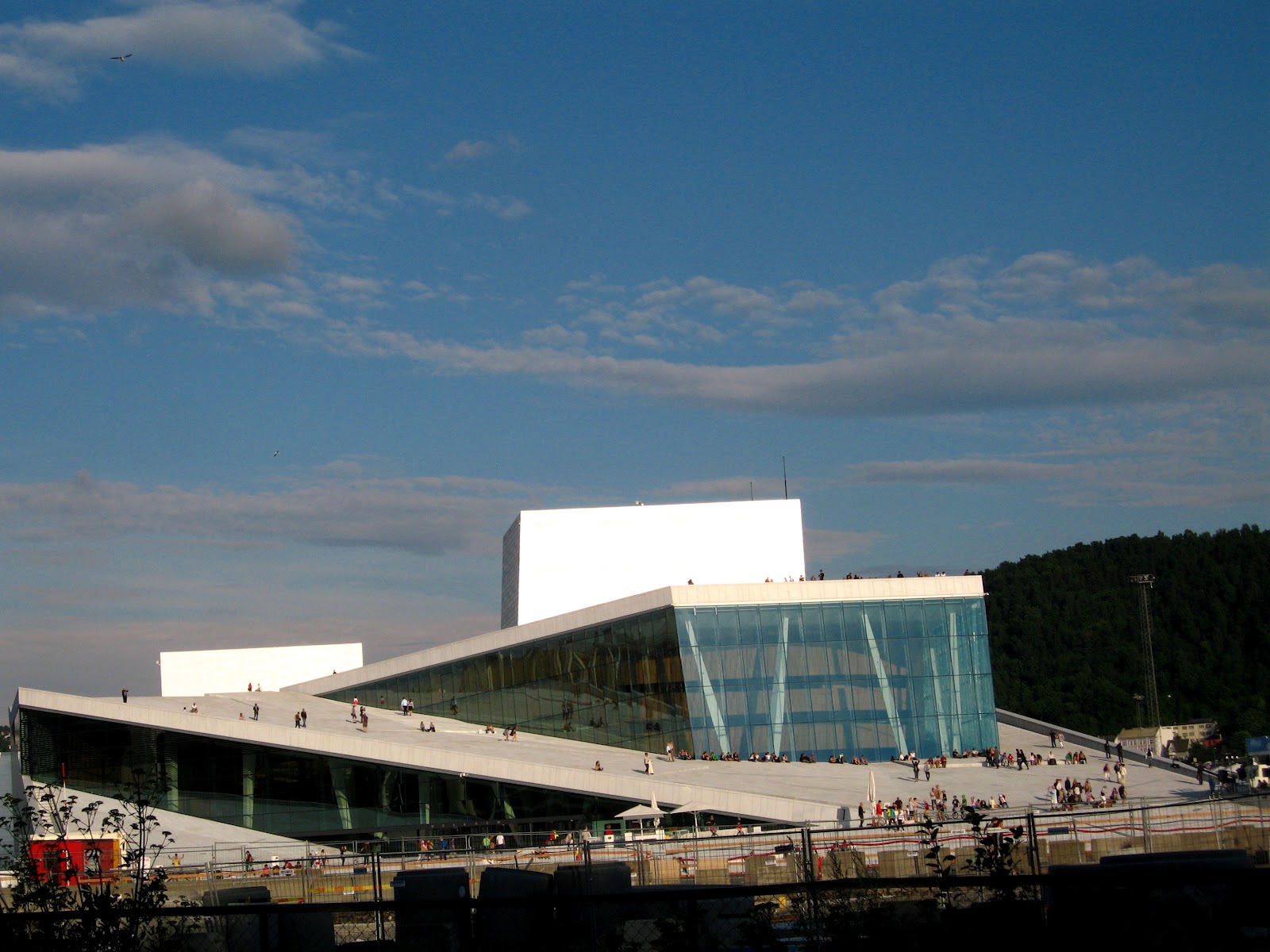
Since most things were closed, we went to the opera house.  Turns out that Oslo isn’t that much easier to navigate with a map.  For some reason, it’s at a confusing angle.   Anyway, we did find a foot bridge that would have led us over the railroad tracks and right to the opera had it not been for the massive construction project in the way.  So, we re-evaluated our route and successfully arrived at our destination on the left. 

The Oslo Opera House is trying to reach the iconic status of the Sydney Opera House and like the Sydney Opera, it is built over the water and has a weird shape.  They went for iceberg inspired theme and you can climb up the marble/granite roof to the top to look over Oslo Fjord and the city.  Of course, when we were there it was raining, but it was still cool.  The inside is also nice, but I thought the outside was more unique.  Interesting fact, courtesy of Wikipedia:  The opera house was finished in 2007 and is the largest cultural building  built in Norway since the Nidarosdomen Cathedral was finished in 1300. 

From there we walked along the harbor to Akershus Castle.  The castle was built around 1300 and was used to defend Oslo.  As time progressed, its function changed and eventually it fell into disrepair in the 18th and 19th centuries.  Now, it is used by the Norwegian government to host foreign dinners and hold meetings and such.  It also houses the government’s ministry defense headquarters.  Since it was later in the evening, all the museums and things were closed, so we just walked around the grounds and looked at the old buildings.  It also has a nice view of the harbor. 
By now, it was nearly 8:00 and we were hungry.   We decided to check out a recommended pizza place called Hell’s Kitchen.  When we arrived it was so full that we couldn’t get a table, but soon one cleared out and we were seated in actual chairs.  We ordered our pizza and drinks and a few minutes later fellow teachers from Bulgaria walked in and took the table right next to us.  Actually, C didn’t even realize we were sitting there until she’d sat down.  We had a good dinner with P and C and heard about their whirlwind trip through every country in Scandinavia.  They only had the evening in Oslo, so we recommended  trip up the Opera House roof and we went back to our hostel to sleep (not that it was dark yet, I mean, it was only 10:00). 

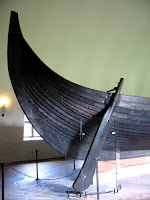
The next day, we decided to get the Oslo Pass.  We went to the tourist information place and acquired our card and then laid out a plan to maximize our money.  We decided to take the ferry over to the Viking Ship museum first.  The museum houses the best examples of preserved Viking artifacts, including three ships: the Oseberg ship, the Gokstad ship, and the Tune ship.  The three ships were once sea-faring vessels but were found in such good condition because they were used as burial ships. 

The Oseberg ship’s occupants were two females buried around 834 but the ship was from the year 800 or earlier.  This boat is big.  70 feet long and 16 feet wide and could be rowed by 30 people.  This ship is ornate and was most likely used by a wealthy family for coastal journeys.  The ship was also filled with a lot of burial relics like ornately carved sleighs and 14 horses.  Most of the other artifacts in the museum came from this ship. 

The Gokstad ship is the biggest one at the museum (76 ft x 17 ft) and it was used for long ocean journeys.  32 oarsmen could power it when it wasn’t using a 1200 sq foot sail.  This was the kind of Viking ship that made trips across the ocean to places like Iceland and North America.  A man was found buried in this ship but most of the artifacts buried with him had been stolen by grave robbers. 

The last ship, the Tune, was in the worst condition.  It dates from the year 900 and was also used as a burial ship.  It is really fragmented, however, so it’s hard to find it as interesting as the other two. 

From the Viking Ship Museum, we decided to visit the Polar Ship Fram Museum.  We mostly decided to go since we were already on that side of the fjord, however I’m so glad we went.  Coolest museum I’ve been to in a while.  The Fram is a Norwegian ship that was used in some of the first successful Artic and Antartic expeditions.  According to Wikipedia, “Fram is said to have sailed farther north (85°57'N) and farther south (78°41'S) than any other wooden ship.”  Even better, the actual ship is inside the museum!  They pulled the ship onto land and built the museum around it.  You can literally walk through the ship (which still smells like diesel fuel) and look at the cabins, kitchen, and game room.  You can also try to get a picture with the steering wheel, but if you’re like me, the old guy photobombing your shot won’t leave. 

Other trips to the great white north ended badly for some wooden ships that were crushed when they became frozen in the ice.  No one thought it was possible for a ship to survive a winter in the artic, but Fridtjof Nansen (who is one of the coolest people ever- no pun intended) thought that a shallow and wide hull would do the trick.  He had Colin Archer design a ship with a heavily reinforced hull of this shape and they ended up with the Fram, which could withstand these forces.  The ship was designed with a windmill to generate power and enough space to allow enough provisions for a crew to live on board for 5 years (signing on for these journeys was a big time commitment). 

Nansen lead the first Arctic journey the Fram took from 1893-1896.  While he made it farther north than any other person had until that time, he didn’t make it to the north pole.  He floated with the arctic ice for over a year before trying to get to the 90o mark via dog sled.  They made it as far as 86.3o in latitude and had to give up.  They experienced a lot of difficulties, as evidenced by the fact that of the 150 dogs that left on the journey, only two made it back to Norway. 

The Fram’s second Arctic expedition was scientific in nature.   In1898, Otto Sverdrup started a 4 year journey to chart the flora and fauna of Arctic Islands.  The Fram’s last journey was to the Antarctic.  Roald Amundsen led this journey, which lasted from 1910-1912.  He was originally planning  to head to the North Pole as well but once 2 Americans beat him to it, he changed his plans.  He had significantly more success with his sled dogs and skies and this became the first expedition to reach the geographic South Pole. 

A brief note on Nansen.  As I said, he was a cool guy.  He was a champion skier and ice skater, explorer, and had a doctorate in marine animal neurology.  He also studied oceanography and earned a Nobel Peace Prize for his work helping refugees affected by WWI.  So… what have you done with your life? 


From the Fram, we took the ferry back to the main part of Oslo and headed back to Akershus Castle.  This time, however, we got to go inside.  We got to tour several rooms including the dungeon, the royal mausoleum, and the castle church.  Since the building was built in the 1300’s, it certainly wasn’t Buckingham Palace as far as fancy goes, but it was still impressive and had some impressive artifacts, such as tapestries from the 17th century. 

Since I was traveling with an English teacher, the next stop was the Ibsen Museum.  What I know about Henrik Ibsen, besides that he had fantastic facial hair, is that he was a great playwright and, based on the museum’s information, dealt a lot with morality and religion.  I’ve never actually seen or read one of his plays, but I have heard of “The Doll’s House.”  The most interesting thing about Ibsen were his eccentricities.  The museum is below his apartments, which you can tour.  The apartment is very nice and the tour comes with great stories about his life.  He planned his day to the minute.  He worked at his desk until the same time every morning.  Then, he got up and followed the same route to the same café to read his papers, some of which he had specially sent in from other countries.  He did the same thing at the same time everyday.  He had a barber come a few times a week to trim that facial hair that I mentioned before and if the barber was even a minute late, he made him leave and come back the next day.  He was fastidious.  He also had a massive portrait of a rival Swedish playwright in his office so he could see the enemy and remember who he was trying to beat.  He was an interesting guy. 

From there, we took a turn around the Royal Palace and the Queen’s Garden.  It is the only park in the world that surrounds a palace and is open to the public.  There isn’t even a fence around the palace.  There are guards with guns so you can’t exactly walk up to the front door, but it’s still really open and meant to be used by the citizens of Oslo. 

We then took in the National Gallery.  We saw The Scream by Edvard Munch along with some Picasso and El Greco.  Everyone knows The Scream so it was great to actually get to see the real thing.  I also decided I really like Hans Gude and other Norwegian landscape painters. 

After that, we hit up the Nobel Peace Center.  They had the “In Afghanistan” exhibit that was featured in National Geographic a few months ago.  It features pictures and stories about women living in Afghanistan and how life is changing for them.  It also had videos on these girls that were working to improve life in their country.  They organized demonstrations on why harassing women on the street is wrong and they organized a trash pickup in one of the cities that a lot of young volunteers turned out for.  It was nice to see good things happening in a place that mostly has bad news coming out of it.  It also includes photos of soldiers in Afghanistan that was really moving. 

Upstairs had a full exhibit on the three women that won the Nobel Peace Prize this year.  ‘The Nobel Peace Prize 2011 was awarded jointly to Ellen Johnson Sirleaf, Leymah Gbowee and Tawakkol Karman "for their non-violent struggle for the safety of women and for women’s rights to full participation in peace-building work".’  Ellen Johnson Sirleaf is the president of Liberia and she fights for women’s rights, Leymah Gbowee led a group of women to literally block a group of men inside a hotel until they reached an agreement and ended the civil war in Liberia, and Tawakkol Karman works to improve women’s rights in Yemen.  They were all really inspirational.  You could also look up all other prize winners on a really cool interactive screen where you could read about what they did, hear bits of their speeches.  It was nice. 

Well, end Oslo Pass attractions.  Since everything was closed, but we had still had free transport, we headed up to the Vigeland Sculpture Park.  The 80 acre park has 212 bronze statues by Gustav Vigeland.  They are all naked people.  There is even a stone column called the Monolith that is covered in bodies.  It’s a little less creepy than it sounds.  Apparently, it took 14 years to carve, so maybe I shouldn’t call it creepy.  It’s also supposed to represent human unity, but it looks like a bunch of writhing bodies.  It was an interesting place.  I especially liked the upside down baby and the fountain. 


To finish our day, we bought our train tickets to Bergen and then headed to the fjord to take a little cruise.  Since we still had free transport and ferries are like subways in Oslo, we got a free fjord tour.  It was a little cold and windy, but also very nice and scenic.  That evening we copped out and ate McDonald’s since it’s cheaper (emphasis on the “er.”  It was still $15). 

The next morning we were off to Bergen on the “most scenic railway in the world.” 

Thursday, July 26, 2012

Part 34: Bruges/ Brugge/Brugges can be Spelled Many Different Ways July 12, 2012

After visiting the Brussels Cathedral, we headed to the train station to catch a train to Bruges.  We bought our tickets, which do not list a platform number or a time.  Since there are so many trains to Bruges each day, it doesn’t matter.  Of course, it makes finding the train a little more difficult.  First, S asked the information desk and he told us a platform.  However, the sign on that platform did not list Bruges as a destination.  Since we would rather be safe than sorry, we abandoned that train and I went to the info desk (so it wouldn’t be the same person) and asked.  He said “platform 9 at 9:56.”  Well, it was 9:55, but we ended up having plenty of time.  And so, we were off. 

Belgium is a pretty, if a little flat and boring, country, so I mostly read my book.  Once in Bruges, we walked toward the city center, using the tall towers of churches and the famous belfry as our guides.  The medieval streets are narrow and the houses are very colorful.  I really enjoyed walking around.  Oddly, we managed to not see a single canal for probably the first 3 or so hours that we were there. 

We saw the Church of Our Lady (finished in the 15 century) with its 401 ft. tower, which still stands as the second tallest brick tower in the world.  We also popped into St. Salvator's Cathedral for a few minutes and heard a performance of Queen of the Night from Mozart’s The Magic Flute.  We eventually ended up at the belfry.

We then got in line to climb it.  Only 70 people can go up the tower at a time because, well, it’s old (rebuilt in 1280) and it apparently leans 1 m to the east.  Also, you walk up 366 steps (272 feet), all in a small circular staircase, so no more than 70 people would really be practical.   You first come to a room that was used to store important documents.  You can still see the iron chests sitting behind iron gates that had 10 different locks that had keys kept by 10 different people (now that’s security).  Then you keep going up and you pass the “Great Bell.”  It is the biggest bell I have ever seen.  It weighs 11,000 pounds and it isn’t really rung that often. 

Above the great bell, you see the carilloner’s room.  The belfry was turned into an instrument in the 16 century and Bruges has employed a carilloner since 1604.  Originally it had 35 bells, but this has since increased to 47.  (side note:  I doubt the Bruges carilloner plays such hits as Thriller or Bad Romance, which makes me glad I went to Iowa State.  Free bell concert everyday at noon where you never know what you’ll hear)

Next you reach the room that basically turns the belfry into a giant music box.  It has a large brass cylinder (apparently the largest in the world) with little tabs that the bells are connected to (similar to the metal bumps that pluck a music box).  Every 2 years, the tabs are moved and the songs that play every quarter hour are changed. 

Then, you finally make it to the top.  You can look out over Bruges see the bells, ect.  Then you have to fight your way back down, which is difficult, with so many people also trying to come up.  Let’s just say, it feels like more than 70, even though it isn’t. 

Next we walked through Burg Square, where city hall and the Basilica of the Holy Blood are located.  We were on our way to the chocolate museum!!  The chocolate museum, or Choco Story, is great.  They make chocolate there, so the building smells awesome and the history of chocolate from the Mayans onward is presented.  It tells how it started as a drink and currency for Mayans and then was brought to Europe where it gained popularity with the upper class.  Eventually, someone started adding sugar to it (thank goodness!) and it really became popular.  The chocolate pot with a “frother” stick was invented and they drank it out of giant mugs (people after my own heart).  Eventually, solid chocolates came to pass and Belgium really started to excel.  They even sell chocolate tins with the royal family on the lid. 

After the tour, we saw a chocolatier give a demo on how they make filled chocolates.  Then, we got samples!!  Best museum ever.  J

After that we walked over to the old fish market which is now used by artists to sell their paintings.  I bought a small watercolor of Bruges before we started walking down the canal.  We even saw the famous dog that always sits in a window over the canal.  I googled him and apparently his name is Fidel. 

Anyway, we wound our way through the streets to the windmills on the far side.  There are 4 windmills still standing.  They were originally from the 1780’s.  Some are original but at least one has been reconstructed.  As will most windmills, they were used to mill grain.  Now, you can tour some of them, but we just walked by and enjoyed the view. 

We also tried to visit a garden that was mentioned on our map.  It said to go inside a door, ring the buzzer, and wait for a nun to let you in.  We were let in, but no nun came to guide us.  We saw a courtyard, but we’re not sure it was the correct one.  Needless to say, we felt awkward and left. 

We then ended up in the main square by the belfry again and got some French fries from a restaurant that will apparently fry whatever your heart desires.  We then decided to find the cannon that is stuck in a sidewalk that no one really knows the story behind.  It also said we probably wouldn’t notice it.  We followed a police marching band (that was playing the Marine corp hymn) in the appropriate direction, and didn’t see it.  We rechecked the map, retraced our steps about 20 feet and there it was:  nose down in the sidewalk, clear as day, and yet completely miss-able. 

Lastly, we walked over to see the traitor’s gate.  In the 15th century, Bruges was walled in and the gates closed every night so armies couldn’t attack.  However, one night, François vander Straeten opened the gate to the French from the inside.   He was later executed as a traitor and his skull was displayed on the gate as a reminder of what would happen to anyone else who tried the same thing.  Francois’s actual skull is long gone, but there is a bronze copy there so the message remains. 

We then headed back to the train station and went back to Brussels for the night. The next day, bright and early, we were off to the airport to fly to Norway!

Wednesday, July 25, 2012

Part 33: Brussels has Good French Fries but Parts of the City Smell like Pee. July 10-12,2012

S and I left for Brussels late Tuesday morning and since our neighbor was nice enough to give us a ride, we saved 8 leva.  WizzAir successfully took off on time for this flight (I waited for 6 hours for my flight to Paris last fall) and we were in Brussels before 3.  After some confusion and our first taste of Belgian French fries, we took the airport shuttle to the train station.  However, as it turns out, Brussels has 4 or 5 train stations and we were at the wrong one.  Luckily, it also has an extensive metro, so we headed downstairs and took our first of what would be many rides on Tram 4. 


First impressions of Brussels are perhaps not the best to base your entire stay on.  For being the capital of the EU, it is sort of dirty and certain places (such as underpasses) smell like pee.  The city centre is, thankfully, much nicer.  However, I never fully lost the feeling that this is a place where you need to be extra conscious of the location of your wallet.

After finding our hostel, we headed to the Grand Place.  The Grand Place is a large square with buildings gilded with gold.  Directly in front of us was the town hall.  It was built in the 1400’s and has a 315 foot belfry tower and is covered by carvings of saints and other figures.  It looks really similar to the gothic town hall in Vienna, even though it was built 400 years later.  Around the town hall, some of the buildings from that time period were covered markets for bread, meat, and cloth.  However, these were torn down as the square became used for government rather than merchant activities.  The name stuck, however, and one of the “new” (from 1536) buildings is still called the bread house.  In 1695, French artillery destroyed much of the Grand Place except for the town hall’s shell.   Since it was all rebuilt at the same time, however, the Grand Place ended up looking great.  The new buildings were built by different craftsmen’s guilds, hence, you can visit the Brewer’s museum in the building originally built by the brewer’s guild.  Overall, you come, you look, you take some pictures, you move on. 

On from the Grand Place to see Manneken Pis.  The little peeing boy statue was originally made in 1619 and is a symbol of Brussels.  Being a symbol, you can buy large copies of it in every tourist shop on your way there.  Then you get to the actually fountain and realize it is about 2 feet tall and he’s the most musclely toddler you've ever seen.  Sometimes the statue is dressed up for different occasions, but when we were there he was naked.  Also, unless you go to Maison du Roi, you’ll see the copy from 1965 (apparently, people liked to steal the statue, so they had to increase security). 


From there, we wandered.  We ended up passing a restaurant that called itself a “Mexican Grill.”  Well, that’s the key word for us, as Mexican is almost impossible to get in Sofia (HIT now carries Old El Paso products, but they’re made in Ireland so….).  We went in and sat down and ended up getting a weird yet tasty Mexican-Arab fusion dinner complete with after dinner mint tea.  Oh, and we got more French fries (that’s 2x in one day, for anyone keeping track).

After this we wandered back towards the Palace of Justice.  It was the biggest building constructed in the 1800’s and bests St. Peter’s Basilica for square footage.  So yeah, it’s huge.  Unfortunately, we didn’t get to go inside and it was surrounded in what is possibly the largest scaffolding set up of the 21st century, but it was still impressive.  Plus, from the back, you can see a great view over the city at sunset.  We then went back to our hostel and went to sleep. 

The next day, we decided to get the Brussels Card.  I love these things.  Several cities around the world have them and if you’re dedicated and well planned, you can more than make them worth your while.  We got out the door early, so we stopped at Jardin Botanique which was near to our hostel (and not near to anything else we were doing that day).  It was the official botanical garden from 1829-1938, and is still a nice garden outside, but the inside is now hosts concerts and exhibitions. 

We then stopped at the Grand Place tourist info desk to buy our Brussels cards.  With the card, you get free entry to over 30 museums, free public transport, and discounts on several other attractions for 24, 48 or 72 hours.  So began our 24 hour whirlwind tour which included several rides on tram 4:


1st Stop:  The Atomium.  The Atomium is a cool monument built for the 1958 Brussels World Fair.  It is in the shape of an iron crystal that has been magnified 165 billion times.  You visit the top sphere by elevator (apparently it was the fastest elevator in Europe in 1958).  From the top sphere, you get a nice view of Brussels and the “Mini Europe” attraction below.  After visiting the top, you take escalators and stairs to several other spheres.  There is a museum on the 58 Expo (I remember reading on a sign that approximately (since I didn’t take notes): 12 babies were born at the expo and 7 people died and over 20,000 liters of beer were served each day) and a museum on world water issues.  It included an ingenious toilet design were you have a sink above the toilet tank and the drain water is used to fill the tank and flush the toilet. 


2nd Stop:  Coudenberg, the former palace of Brussels.  Cooler than it sounds since most of it is under the current palace of Brussels. It was built in the 11th century and was used by the royal family until it was destroyed by fire in 1731.  They didn’t have the funds to rebuild, so the remains sat there for 40 years.  By the time rebuilding started in 1771, the style had changed.  The original sight was very hilly, but it was popular at the time to create large open squares.  So, they filled in the ruins with dirt, leveled out the hill, and build a huge (flat) square surrounded by official buildings.  Since they filled it in and it has since been excavated, you can walk through the foundations of a large portion of the former palace and see highlights like the latrine cesspool, a “waste disposal conduit,” and the former level of Rue Isabelle street.  You can walk down the hill on the original street underground and then you can go above ground and walk on the “new” level one.  It was cool. 


3rd Stop:  The Musical Instrument Museum.  First of all, it is housed in the coolest art nouveau building that used to be and Old England Department Store (I really want to live there).  Next, it has over 8,000 instruments, the largest collection in the world.  Last, you get headphones at the front desk that you can plug in by the displays to hear the instruments playing.  I listened to everything from clanging Tibetan chimes to harps to bagpipes.  I also learned that the saxophone was invented by a Belgian named Adolphe Sax in the 1840’s (and now the name makes sense).  And, not that I needed any more reasons to love this museum, there is an entire floor (that’s right, floor) dedicated mostly to pianos, harpsichords, and similar yet totally weird instruments like a lutheal (the only one in existence) and a geigenwerk (stringed like a piano but uses a circular bow to play it, aka:  violin orchestra).  There is also a nice view from the top floor windows. 


4th Stop:  Belgian Brewer’s Museum.  It is not that good of a museum.  There is basically one room showing brewing equipment and a boring video.  However, it is free with the Brussels card and you get free beer at the end (if you like beer).


5th Stop:  The Halle Gate, built in 1381.  Brussels used to be a walled city and this is the only surviving medieval gate (it survived due to its functionality as a prison).  Apparently there used to be a moat and a drawbridge, but these are gone.  Also, in the 1880’s it was “restored” and some trendy gothic elements were added, so it doesn’t look exactly like it did in 1381.  Luckily, the 20th century additions include an elevator to the top.  You get a nice view of Brussels from the ramparts and you can take the loooong and high winding staircase back down, visiting museum rooms on the way.  We saw armor, cannons, you know, the usual.  We also tried on some armor before we left.  S went all out (every piece was on), I was a bit more reserved (breastplate and helmet only).  As we walked back towards the metro snapping some last pictures of the gate, a creepy man asked to take a picture with us, which then cut our picture taking short as we quickly left.


6th Stop:  The Comic Strip Museum.  It is also housed in a cool art nouveau building (not as good as the instrument museum) and shows the history of comic strips from around the world, though clearly more focused on Belgian comics.  The most famous Belgian comic is Tintin, but did you know that The Smurfs are from Belgium?  Neither did I.  This museum would have been more interesting had it not been hot.  Plus it smelled of French fries and we were hungry. 


7th Stop:  The Magritte Museum.  René Magritte was Belgium’s most famous surrealist artist, and I like surrealism.  While in my opinion he’s not as good as Dali, I still liked the museum.  Even though you don’t realize it, you’ve seen some of his paintings.  For example, the guy in the bowler with the apple in front of his face or the train coming out of the fireplace. 

8th Stop:  Subway (the restaurant).  We were hungry.

9th Stop:  Galeries Royales Saint-Hubert.  This is a covered shopping center from 1847 that is full of antique stores, chocolate stores, cafes, and such.  Apparently, since Brussels has such poor weather, the glass covered shops allowed people to feel “outside” without getting wet. 


10th Stop:  Parc du Cinquantenaire and the triumphal arch.  Most of the park’s buildings were built in 1880 to mark the 50th anniversary of Belgian independence.  The park is very large and really nice and the arch is really impressive and flanked by 2 museums (which we didn’t visit…). 


11th Stop:  Parc de Bruxelles.  The royal park is across from the palace and currently holds artisitic representations of traditional Belgian foods.  It is similar to the Kansas City Cow Parade in that Brussels sprouts, beer, chocolate, mussels, and French fries are all decorated by artists to represent different themes.  I enjoyed the French fries the most.  The beer and chocolate ones were kind of lame (much as I hate to say anything bad about chocolate). 


12th Stop:  Église Royale Sainte-Marie, a church just down the road from our hostel.  It was built to lie on the path that the royals took between their two palaces. 

Last stop:  Our hostel.  Finally.  Sleep.
The next morning we visited the St. Michael and St. Gudula Cathedral which was finished in the mid-15 century.  It is really bright and nice.  They also have a carillon and a huge organ. 


Then we headed off to spend the day in Bruges…

Tuesday, July 10, 2012

Part 32: Sofia When It Sizzles

And it has really been sizzling.  It hasn’t been as hot as the Midwest (106o F for 2 straight weeks for my sister) but it has been in the upper 90’s and I realized I have never lived in a place that so closely approximates a brick oven.  Campus, with its glorious trees is probably close to 10o’s cooler than Mladost and the Centre. 

Well, school finally ended!  With the exception of the failing student that had to take a comprehensive year test and pass to transfer to another school (weird law), I haven’t touched school-related things in nearly two weeks!  It’s great!  It almost makes me forget how much I hate the last 2 weeks of school with its mountains of forms and grading. 

With that behind us, we decided to check our Boom Burger for the 4th of July.  It is as close to an American hamburger as you can get in Sofia (or so I hear.  I don’t eat cow).  It isn’t cheap but, it is authentic.  Cheese, bacon, sauce, and the BEST French fries (they were so good- it’s a good thing it’s an expensive place to eat).  I attempted to get the Boom Burger with chicken instead of beef.  When my sandwich came, it was not the Boom Burger (it was missing bacon), but it was still good, whatever it was.  

After eating gorging ourselves at Boom Burger, we got ice cream (yep, but as my cousin says, “Ice cream really isn’t that filling.”) and went to the park to check out “Chicago Days.”  They had a blues band, but I wasn’t a huge fan.  I didn’t like their singing, though their instruments sounded good.  I might be a little spoiled in the blues department, having moved here from Kansas City. 

On the 7th of July, the American Chamber of Commerce 4th of July Party took place on campus.  It was an event.  Two days before, at least 10 tents (including a giant pavilion) were erected on campus, along with soda fridges, carnival rides for kids, outdoor lighting, and probably 100 picnic tables (I am not exaggerating).  Oh! And a stage with a dance floor in front.  It was pretty incredible. 

Starting at noon on the 7th, my roommate were subjected to what turned out to be 5 hours of sound checks.  5 hours.  “Hey.  Hey.  Hey, Ross.”  Over and over and over again.  Scattered in bass and guitar riffs and pieces of 80’s (naturally) songs.  I was so glad when the party started so the noise would have some sort of direction.  I don’t remember the band’s name that played, but they are opening for Guns N’Roses when they come to Sofia this summer, so they were pretty good. 

Now, on to the food.  With your ticket to get into the party (which all school employees got for free) you got a lot of free food.  At the McDonald’s tent, you got a bag with fries, chicken nuggets, a cheeseburger, and a salad (to cancel the effect of the previous things???).  At the McCafe tent (because they were different):  ICE CREAM SUNDAE!  You could also get free pop (or water, in my case), free hamburgers (not for me), cupcakes, other dessert things, and, as quoted from the ticket, “Lots of Beer” (blah). 

There were hundreds of people there and perhaps some rope to keep them out of our yards is needed for next year.   I came out my front door and saw strangers sitting at our picnic table.  The president of the school also yelled at some people that were peeing in our backyard (and they were American… eyeroll).  Not to mention all the people generally inspecting our homes.  I understand that I live in a very unique place, but it’s disconcerting to have a lot of strangers milling around your house, looking in the windows. 
Overall, it was fun.  Today, I leave for Brussels and then I’m off to Norway and I’m coming home via Greece (believe it or not, this was the cheapest way to fly).  So, more to come.  Also, I’ll have to write a belated post about my adventures in Serbia.  I might have my blog updated by the end of August.  We’ll see…. 

St. Nedyla Church, Sofia