Saturday, September 22, 2012

Part 41: Vienna….again August 22-24, 2012


We arrived in Vienna and took the metro to the city centre to find our hotel, which was supposedly somewhere near the Opera House.  Well, it wasn’t that far from the Opera House, I think “near” was an overstatement.  My mom stayed at the hotel to rest and my dad and I went out to explore and to buy 3 day passes for the public transportation system- which is amazing, by the way.

We saw the main shopping district and toured the Church of the Capuchin Friars Imperial Crypt.  I went through the crypt my first trip to Vienna and it is still impressive.  We also wandered around Hofburg Palace and saw the Lipizar stallions’ stables.  We then met up with my mom at the hotel to go to Schonbrunn Palace. 

I was excited about going to Schonbrunn since I didn’t go there during my first trip to Vienna.  I’m glad I didn’t go then because Schonbrunn has amazing gardens and gardens are decidedly less exciting in the winter.  Schonbrunn was the summer palace for the Hapsburgs and was built in 1695 and 1713.  It is yellow (which I found out later was an official royal color in Austria) and the interior is, as with most palaces, amazing.  You can’t take pictures inside, but my favorite room was the grand gallery.  It is 130 ft long with an arched roof painted with amazing murals.  I also liked the Blue Chinese Salon, because as anyone who has seen my wardrobe can attest, I like blue. 

We wandered around the gardens and then my dad and I walked up to the Gloriette.  This is a large pavilion used originally as a dining hall.  It overlooks the gardens and the palace and now holds a café.  We came back down and, since it was really hot out, went to the restaurant to try and eat dinner.  It was about 5:30 when we did this, but unfortunately they don’t serve dinner until 6:30, so we sat there.  It was hot.  Our dinner finally did come and it was delicious.  I had the vegetarian option, since boiled beef didn’t sound appealing and I don’t really eat beef.  I started with really good tomato soup (even though it was hot) and then I got some sort of spinach, potato, onion thingy wrapped in phyllo dough with a really good salad on the side.  Strudel (of course) was served for dessert, but I don’t actually care for strudel (or pie type pastries in general) so I just ate the crust. 

From there we went to the Orangery.  Orangeries are so named because they were like giant green houses used to hold orange trees and other tropical plants from palace gardens during the winter.  Now, the Orangery at Schonbrunn hosts concerts.  We looked terrible, since we had been sweating all day, but the concert hall was fairly cool and the concert was good.  The concert featured a small orchestra that played compositions by Austrians (Blue Danube Waltz, anyone?) and had dancers and opera singers. 

The next day started out with breakfast at McDonalds (because it was just down the street from the hotel and it was cheap) where my dad asked me if the breakfast McChicken was good “for breakfast.”  I’ve eaten so much weird stuff for breakfast lately, that as long as I’m full, I don’t care.  We then went to tour the opera house.  I toured the opera the last time I was in Vienna, but this time I took some notes (not kidding). 

The Opera house was partially destroyed by Allied bombing during WWII, but has since been rebuilt.  The original parts of the Opera house are amazing.  The Emperor’s room and even the front entry have incredible ceilings and gold trimmings.  The rest is still really nice, but you can tell it was built in the 1950’s.  Now, the stage.  The flies are 82 feet high, the stage has lifts that can rise and drop nearly 40 feet below the stage (one lift is for trucks) and the entire stage is about 250 feet deep.  It’s really big.  That’s what I took notes on.  We also went to the opera museum to see the costumes.  I also got to see my dad try out the ballet position tutorial taped to the floor.  (see picture)

From there my dad and I went to see if we could get boat tickets to Bratislava for the next day.  We also stopped at a post office to see about stamps, but they only sell stamps in packages of 4 (only country I’ve ever been to that won’t sell one stamp), so I just got one stamp from the hotel desk.  Unfortunately, the boat was sold out, so we would be taking the train. 

We met my mom and went to the meeting place for our Segway Tour.  Since my mom has trouble walking, these tours are a really great way for her to see more of the city.  We met up, signed our lives away, and were trained in stopping, starting, and turning.  We then headed out. 


First stop:  Hofburg Palace.  (my first Vienna entry talks a lot about this, so go there if you want to read more).  We also saw the parliament, town hall, Beethoven’s Vienna apartment, and St. Stephen’s Cathedral.  A monument to Gutenberg was near where we stopped to get ice cream, and from there our guide took us to the Jesuit Church which has the most amazing interior.  It was built in the 1600’s and the outside is not much to look at.  However, on the inside, the vaulted ceiling is painted to look like it has a dome. 


Our guide also showed us a model of what medieval Vienna looked like (and some wall remnants) and  some concert halls and the standard monument to the Russian soldier, which are basically found in all countries liberated by Russia during the second World War.  We stopped for a good look at St. Karl’s church (built out of thankfulness for the Black Plague ending) and then made our way back to the Segway tour place by way of “The 3rd Man” underground tour start site.  You can literally tour the tunnels where the movie was filmed. 

My parents and I decided to go see the inside of St. Stephen’s and then we went to Figlmuller, a restaurant famous for its giant Schnitzle.  It also makes the best potato-spinach salad ever.  It was soooo good. 


The next morning, we went to tour Hapsburg Palace.  When touring the palace, you get to see the Royal silver and china collection, which fills up rooms and rooms.  It is one of the most ostentatious things I’ve ever seen (and now I’ve seen in twice).  You then enter the Sissy Museum, which gives you a look into the life of Empress Elizabeth.  She has the standard “I hate being royal” tale and really became much more popular after her assassination than she ever was while alive.  Lastly, you see the private rooms of the emperor and empress in the palace.  They are mostly decorated in red and I probably couldn’t even afford the fabric that the furniture is upholstered in. 
From the Hofburg, we caught the tram to the south train station to catch a train to Bratislava, Slovakia for the rest of the day.

Monday, September 10, 2012

Part 40: Mom, Dad, Meet Sofia August 20-22

On August 20 around 2:00 pm, my parents landed in Sofia.  This is most likely a location that up until a year ago was not on their list of places to see.  We hopped in an OK Taxi and headed towards my house.  The meter of the cab was broken, but luckily, it only cost us 8 lev (which is actually about 1 lev more than it would have cost with an operation meter, but since we had to agree on a price, I didn’t want to have to haggle). 

Once at the house, we dropped off their luggage and headed to Luchoni’s for lunch.  They tried the traditional (and somewhat obligatory) Shopska salad and some pizza with corn and pickles (I know, it sounds weird, but the pickles work).  After we got home, they slept for a couple of hours.   When they woke up, they tried Bake Rolls and my favorite ringed cracker thingys that I don't know the name of in English.  Carbohydrates for everyone!

The next day, we were off in a taxi to take in the Free Sofia Tour, which leaves every day at 11 am and 6 pm from the Palace of Justice.  The tour is great.  You see all the major sites in Sofia and learn some really interesting history on the way.  From the Palace of Justice (which serves exactly the function the name would imply) we went to Sveta Nedelya Church where we heard about how the Bulgarian Communist Party blew the roof off the church during a general’s funeral, killing 150 people in 1925.  Our guide said they were trying to kill the tsar of Bulgaria as well, but he survived because he was late. 

As we passed by the Sofia Statue, we learned that contrary to popular belief, it is not St. Sofia for two reasons.  1) Her dress is much too sexy for a saint and the priests in town were horrified at the thought of her still representing the saint and 2)  She has an owl on her arm, which is a pagan symbol for wisdom.  Even if she’s not St. Sofia, she is still the symbol of the city. 

Down the stairs to the underpass that leads to the Serdika Metro stop, we found the Church of St Petka of the Saddlers.  This church was built in the 14th century and has murals dating from that century inside.  The church is “of the Saddlers” because during Ottoman rule, the funding for churches had to come from private donations and saddle makers paid for this one. 

As we continued walking, we passed by the ruins of the Roman city Serdika, before stopping at what is known as Tolerance Square.  This spot is so named because there is an Orthodox Church, a Catholic church, a mosque, and a synagogue (the 3rd largest in Europe) all located within a block of each other. 

From there we moved on to the Public Mineral Baths.  Sofia sits on natural hot springs and this bath house was in use until 1986.  Unfortunately, the baths are currently not working (though some outside the city are still operational), but they are being restored… sort of. 

We passed by the president’s office to see the Rotunda of Saint George, the oldest building in Sofia.  It was built in the 4th century by the Romans and has paintings inside from the 10th-14th centuries.  From there we went passed the Archeological Museum, National Bank, Ethnographic Museum and National Gallery, to the National Theatre.  We also got to hear about the Georgi Dimitrov mausoleum, which was located near the theatre. 

Georgi Dimitrov was the first communist leader of Bulgaria after WWII.  He died on a trip to Moscow (insert conspiracy theory here) and the party leaders back in Sofia decided to build him a magnificent mausoleum in just 6 days.  In 1999, the mausoleum was torn down and guess how long it took?  That’s right, 6 days.  Apparently, concrete and marble takes a while to deconstruct, especially when it’s built to withstand a nuclear attack. 

On to St. Sofia Church and Alexander Nevski Cathedral.  St. Sofia (or Hagia Sophia) is from the 6th century and is located at the highest elevation of the city.  According to our guide, it was a major meeting point for people in the past as it was near a market.  The memorial for the unknown soldier is also located at this church. 

Nevski is the 2nd largest Orthodox cathedral in the Balkans and will hold 10,000 people.  It was finished in 1912 and is actually named after a Russian saint as a thank-you to the Russians for helping Bulgaria gain independence from Ottoman Rule.  It is a huge church and serves as one of my main navigation points in the city.  It’s hard to miss. 

After finishing the walking tour, we grabbed some doners on Shishman and then walked back to see the inside of Nevski and the Rotunda.  Then, we came back home because, it was hot.  We watched the “Fine Living” channel, which is basically HGTV under a different name- even most of the shows are the same- before going to bed.  The next day, we woke up to catch our flight to Vienna.   

Sunday, September 9, 2012

Part 39: Hanging out with the Thessalonians July 21-22, 2012


After reaching Thessaloniki, we caught the bus into town and dropped our stuff off at our hotel.  That’s right, in countries that are not Norway, I can afford hotels.  After resting for a little bit, we started walking through the city.  We found our way to the harbor and began to walk along the water towards the White Tower.  The White Tower currently standing was built sometime after 1430 by the Ottomans.  An inscription above the door dates it to the 1530’s, but it could be older.  It was part of Thessaloniki’s city walls and it was a main fortification point. 

From there we caught the city bus #50 that serves as a tour bus.  It’s actually an ingenious idea.  A regular city bus runs a route that goes by all major tourist attractions and a guide points them out.  You can get on and off as many times as you want that day for 2 euro.  I would highly recommend it, especially if you want to visit the upper walls as they are on top of a giant hill and Greece is really hot in July.    


We saw many sites on our way up the hill, such as the University, town hall, YMCA, and several churches and ruins (Greece really is full of old stuff).  We hopped off the bus at the Trigonia Tower.  The tower is still connected to what remains of the 4th century AD a Byzantine fortification wall.   While the walls are older, the tower itself is most likely the same age as the White Tower on the harbor below. 

While on top of the hill, we grabbed some ice cream and we visited a monastery.  The Vlatadon Monastery founded about 1360 and is usually visited because of the paintings from the 1300’s that decorate the building.  Unfortunately, when we were there, the church was closed.  We did, however, see some peacocks. 

We walked around the walls and then headed back to the bus, where, as it turned out, I had left my camera case.  That was a lucky break.  The bus wound through the city hearing about the Hagia Sofia (a much smaller copy of the giant structure in Istanbul) and the location of Atatürk’s birthplace (first president of the Republic of Turkey). 


After making back to the start of the bus tour we visited the Arch of Galerius and Rotunda.  The Arch and church are from the 4th century and were built by the Emperor Galerius to connect to his palace.  The Arch used to be covered in marble reliefs, however, now only a few survive.  The Rotunda Church has 6m thick walls and was initially built to be either a temple or a mausoleum.  However, after Galerius died he wasn’t buried there and the building wasn’t used until Emperor Constantine I had it converted to a church in the 4th century.  It was used as a church for 1200 years until the Ottomans took over and converted it to a mosque in 1590.  Then, it was converted back to a church in 1912 after the Greeks got the city back during the first Balkan War .  Unfortunately, we couldn’t go inside because it was too late in the day.  Greek museums close at 3 pm these days due to budget constraints.  However, the inside is supposed to have great mosaics. 

From there, we wandered into yet another monastery with some amazing paintings on the outside.  Then, we grabbed some salads at McDonalds and headed back to the hotel to shower and sit in the air conditioning.  The next morning, I went to a bakery to grab some breakfast before we caught the bus back to Bulgaria.  All was going well until the border.  There was a problem with the computer systems and since the bus had 2 non-Bulgarian passengers on it, we caused everyone to have to sit at the border for almost 3 hours before the computer problem was fixed and we were correctly processed.  Yay technology!  Anyway, I’m a little late in finishing my Belgium-Norway-Greece adventure, but I finally got to it. 

Friday, August 17, 2012

Part 38: 7 Hours on a Bus. 0 Hours Bored. July 19-21, 2012

On the 19th we left the lodge on one of the first buses and ferried back over Stavanger fjord to the town.  We then had to walk a really long way to our hostel.  It was 30 minutes from the city center, which is fine, but when you have all of your stuff, it’s not that fun.  After dropping our stuff off, we hiked back into town to see the city and arrange our bus transportation back to Oslo on the 20th. 


The man at the bus station was extremely nice and really wanted to help us get the cheapest bus.  He gave us several time tables and bus companies and then sent us to the Stavanger public library to buy our tickets online, since buying online also save you money.  He also gave use gummy cars (like gummy bears, but, you know, car-shaped).  We headed to the library, but got confused and used a café’s computer instead.  We looked up the companies he gave us, but they were more expensive than the national bus line that we found.  We wanted to be sure it was ok, so we walked back to the station to confirm that it would work.  He said we should take that one, even though it was a little longer, but it would work. 

We went back to the library this time and bought and printed our bus tickets.  The library has a “tourist only” computer that we could print from.  Apparently, this is a common need in this town.  After we had our bus tickets in hand, we set out to explore.  We didn’t make it very far, since S decided to grab a frosty from McDonald’s.  After that, though, we were unstoppable. 

The first site we happened across, since we didn’t really have a plan, was Valberg Tower.  This tower was built in 1853 as a fire watch tower.  Most buildings in Norway are made of wood, so fires are a definite risk.  We didn’t go in, but apparently it is now used as an art gallery.  From there, we wandered down into the old town. 

The old town is very quaint.  If you ignore the Burger King and the giant cruise ships, I imagine it looks about the same as it did 100 or more years ago.  We were asked earlier in the day if we were on a cruise and we soon figured out why.  Based on the 3 ships currently docked in Stavanger, there were at least 10,000 extra people in that town.  We walked along the fjord, admiring the water, the old wooden buildings, and stone churches.  We also wandered past the Stavanger Oil Museum and got to look at the rig and dike equipment that they had sitting out.  One definitely looked like a missile until I read the sign.  We eventually headed back to our hostel. 

The next morning, our stuff once again in tow, we were off to the bus station.  I saw the bus station man again and he gave me more gummy cars, which I ate right away in spite of it being 9 am.  When we boarded our bus it was us, our driver, and an Israeli couple.  It was great!  The couple was really nice and the bus driver talked to us off and on and gave us information about where to get the best pictures.  We were basically about to cut across the country for the next 5 hours… and I was so excited. 

It looked like it was going to rain on us as we pulled out of the city and I was a little disappointed, but it quickly cleared off and was sunny for the rest of our trip.  S told me to wake her up if she was missing anything amazing.  By my count, it was all amazing.  Once again, mountains and water and water falls and snow and sheep.  I did not close my eyes the entire time. 

We picked up more people as we made stops along the way and we eventually turned onto a crazy, one-lane mountain road and started climbing up and up and up.  As we turned through switchbacks and met other cars head on, I found that I was still less scared than I am in taxis in Sofia.  And the view was certainly better.  At the highest point in the road, we were blocked by sheep.  I think the driver said it was 1800 meters high, but like I said, there were sheep, so I was distracted. 

Eventually we made it to the town where we had to transfer buses.  After that it was another 2 hours to Oslo.  We drove past the most amazing, huge, inland lake.  The road went by it for over 30 minutes.  We were also in farm country, so it was really pretty with fields and red barns.  I loved it!  It would have only been better if I could have skipped the bus and hiked the whole way (which was cost and time prohibited, unfortunately).   

After we arrived in Oslo, we stayed at the same hostel that we did on our first trip through and then headed out to spend our last Kroners on real dinner.  We went to Peppe’s Pizza.  I had a delicious calzone and got tap water (not bottled) in a glass.  With ice.  It was like a little piece of America on the table. 

Then we went back to our hostel and slept until 3 am.  We had to catch the 4 am airport shuttle.  I definitely closed my eyes on that bus.  We arrived at Oslo Rygge Airport with more than enough time to catch our flight to Thessaloniki, Greece (because, believe it or not, the cheapest way to get back to Bulgaria is via Greece). 

Wednesday, August 15, 2012

Part 37: Buses and Boats: Take Me Away July 17-18, 2012


Bright and early Tuesday morning, S and I were off to the bus station to catch the bus to Stavanger.  I was a little shocked that our 5 hour bus ticket cost more than our 7 hour train ticket, but it made more sense later on that day.  We boarded the bus, which had Wi-Fi and settled in for our journey. 


I slept quite a bit on this bus ride, which I always feel guilty for.  When I travel I feel like I need to see everything that’s around me, not the inside of my eyelids.  Apparently, I even missed a 20 minute stop where S completely left the bus.  However, I still managed to see a lot of beautiful fjord land.  There were mountains and water and more mountains and then more water.  And then, we drove onto a ferry and were told by the bus driver to be back to the bus 5 minutes before we docked.

I’m sure the fjord we crossed was very beautiful.  However, it was foggy and rainy so I actually have no idea what it looked like.  Back on the bus.  More mountains and water and then… another ferry.  Once again, we needed to be back on the bus 5 minutes before we docked.  The weather had cleared a little, so this journey was more scenic, but we still couldn’t see much.  The two fairly long ferry rides made our expensive bus ticket make a little more sense. 

We arrived in Stavanger around 1:30 that afternoon and headed to the tourist information desk.  We needed a map and a grocery store.  We weren’t staying in Stavanger and we didn’t want to have to eat at the only (expensive) restaurant near our hostel for the next 2 days so we stocked up on supplies before heading to the docks.


Ferry ride #3 of the day was the most scenic.  Most of the clouds had moved off and the sun was sort of shining.  There were islands and mountains all around and very blue water.  We docked in the village of Tau and caught yet another bus up to Preikestolen Mountain Lodge and Hostel.  Our hostel was in a small wooden building with a grass covered roof that was cute as could be and had a great view of a lake. 

I wanted hike to Kjeragbolten, which was nearby, however there is apparently no good public transit between our hostel and the ferry to the trailhead so I had to let go of that dream after talking with the hotel receptionist about it.  That evening I took some pictures around the lake and S and I talked to our roommate from Finland. 

The next day, we set out for Preikestolen, or Pulpit Rock.  The rock formation was formed by a glacier and sits 1,982 feet above Lysefjorden.  We stayed right by the trail head so it was only a 2.4 mile hike but most of it was up, so it still takes 3-4 hours roundtrip.  Also, Norway’s traditional trail style is to dump a bunch of boulders on the ground.  While they do keep your feet out of the mud, they make for tricky climbing, especially on the way down. 

The hike up was gorgeous (see picture collage above).  We left early enough that the trail was not very busy and we made good time.  We hiked up boulder covered stream, across a green, wet valley, and past several mountain lakes that you can apparently swim in but I didn’t think it was nearly warm enough for that.  We finally reached the top and it was a sight. 


First of all, you’re really, really high.  I don’t particularly care for heights, but I don’t mind being high up on a mountain so I was ok.  You’re also overlooking Lysefjord and it is beautiful.  I even found a little boulder wedged into a crack between two cliffs to stand on as a joking replacement for missing Kjeragbolten.  We then took pictures of each of us on the edge of Preikestolen, climbed up above for the view down and after eating some bananas headed back down. 

I always find down to be much harder than up when hiking.  It’s the only time my knees complain (I’ve been lucky in that regard) and I inevitably trip or fall at least once.  However, when I did almost fall on the boulder covered stream going down, I was caught by a guy going up that had really quick reflexes.  My hero, swoon.  Haha.  I managed to make it without incurring any serious injury and when we were close to being back down, we decided to take another trail on a whim to see where it led. 

This trail led through the woods up a mountain.  When you come out you’re at a place that overlooks Stavanger Fjord, which is huge and blue and beautiful.  We were also at a place that has a really great echo if you yell.  Luckily the family that was there just ahead of it demonstrated it very well so I didn’t have to yell myself.  More pictures and then we headed back down. 
By the time we were at back to the original trail, my ankles were done.  I had to work really hard not to roll them over.  At the bottom, I took a picture with the Preikestolen sign and while S went to hike around the lake, I took a shower and rested my feet.  Later that evening I ate a chocolate bar before going to sleep.  It cost about $4, but it was worth it.

The next day, we were taking the ferry back to Stavanger.  However, this was my favorite part of the trip. 

Tuesday, August 14, 2012

Part 36: Beautiful Blustery Bergen July 15-16, 2012

On the morning of the 15th we headed to the Oslo train station to catch the train to Bergen.  Unfortunately, the railroad is undergoing a lot of construction so you have to catch a bus to a different station outside of Oslo before catching the train.  The guy directing the masses to the correct bus line gave instructions to the people in front of us in English and then gave them to me in Norwegian.  Apparently I looked like a native. 

The bus took us to a small town train station that was not equipped to handle this much traffic.  The line for the bathroom filled the small waiting room inside the station.  S and I decided we could wait.  The train arrived a little later and we found our seats.  S was at the front of the car and I was at the very back.  On the up side, I did not have a seat partner, so I could spread out. 

The Bergen railway is “the world’s best train ride” according to the Norwegian tourism website.  Of course, they’re biased but I have to agree.  I spent most of the train ride staring out the window in amazement completely jealous of the fact that some people get to live there.  It was unbelievably beautiful.  S got to sit by an English professor and her husband who described it as “The Lord of the Rings with phone lines.”  Personally, I think Norway has Middle Earth beat. 

After about 7 hours we arrived in Bergen.  Luckily, Bergen is smaller and makes more sense on a map than Oslo.  Plus, our hostel was merely 5 minutes from the train station.  No extra directions necessary.  After dropping our stuff off in the 50 person dorm (we were travelling on a budget) we headed down to explore the city.  We walked downtown past many old churches and buildings from the 1700’s.  We reached the main square and looked at all the Norwegian tourist junk such as sweaters, moose key chains, and slippers.  Just on from there, right on the wharf, is the fish market.  It is big and it smells like, well, fish. 

One side of the wharf is named Bryggen.  It consists of several wooden buildings that were built by the Hanseatic Trade League from between the Late Middle Ages and early modern period (c. 13th–17th centuries).  The wooden buildings are in great shape for as old as they are.  Most of the buildings on Bergen’s wharf are from the 17th century, but that’s still 400 years old!  

We then walked past Bryggen and on to Bergenhus fortress.  This fortress was once the seat of the king and the currently buildings date from the 13th century.  S had to see Rosenkrantz tower since Rosenkrantz is a character in Hamlet and S is an English teacher.  I don’t think it’s the same Rosenkrantz, since Hamelt takes place in Denmark, but it’s still a good picture for an English teacher’s wall. 

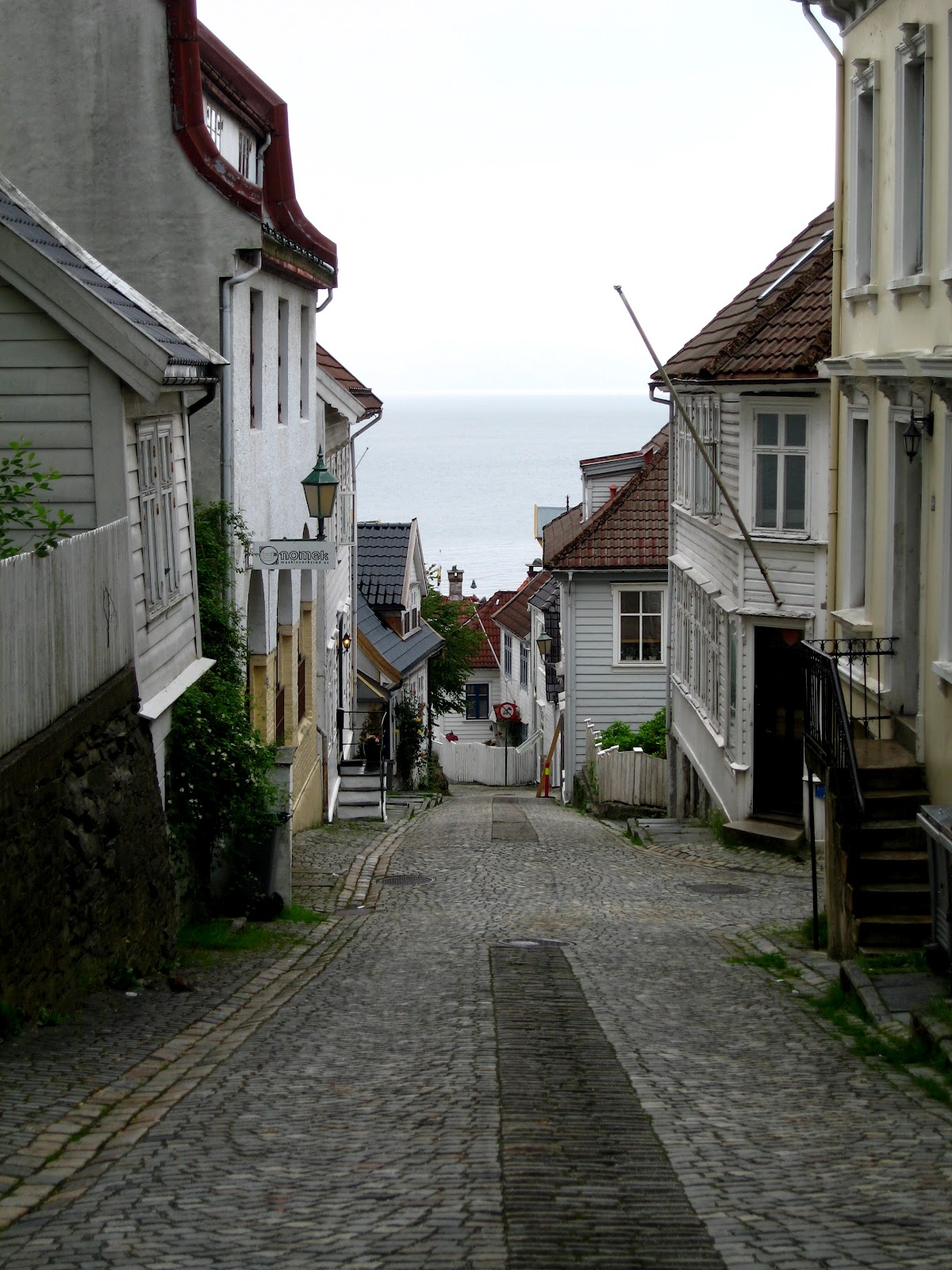
The fortress continues at a higher elevation that gives a good view of the city (or it would have if it hadn’t been raining while we were there).  On our way up we walked around by the water and then up through the narrow old streets of Bergen past cute wooden Norwegian houses.  On our way back down, we passed through Bryggen and looked in the narrow hallways between the buildings before stoping at Subway for dinner (a $9 sandwich, yikes!).  We then meandered up towards a nice brick church and back through the university museums and park.  Finally we went back to our hostel to read, check our email, and sleep. 

The next day, we decided to visit Fantoft Stave Church.  The original Stave Church was a traiditonal wooden church dating from 1150.  It survived for over 800 years and was even moved to Bergen from its original site only to be destroyed by arson in 1992.  However, they rebuilt an exact copy and while it’s not old, it is cool.  The church shows how early Norwegian Christians used tree logs as pillars and it had carvings that reminded me of what I’d seen at the Viking ship museum in Oslo.  The church was far from the center of town, so we took the tram there and back.

When we arrived back in town, it we decided to take the Fløibanen funicular up Fløyen, a mountain plateau that rises over Bergen.  However, we timed it so we showed up with the bus/cruise ship tours.  Not wanting to stand in a huge line in the rain, we stopped into a café for some $6 coffee and hot chocolate and waited out the line and the rain.  It worked out very nicely and after we came back out we waited only a few minutes before we were on our way up the mountain.  It would have been a better view if it hadn’t started raining again, but it was still amazing. 

When we got off, we tried to take some pictures, but the rain was brutal, so we stood in the long line for the women’s bathroom (it’s an international problem) that was at least covered and then we checked out the tourist shop and waited for it to stop raining.  We took some pictures, but they still weren’t very good, so we decided to hike to a lake.  We got to the lake and saw a sign pointing us to another destination that I didn’t actually note the name of.  We decided, on a whim, to take it. 

We walked along a squishy moss-covered trail (that, yes, I slipped and fell on once) through a fern covered forest.  It was really different from other woods that I’ve walked through.  Rocks, ferns, and moss.  The floor wasn’t covered in leaves and underbrush.  It was beautiful.  We ended up climbing to the top of a mountain that overlooked Bergen on one side and a small mountain lake on the other.  It was awesome. 


We also successfully made it back down and I managed to avoid most of the mud, which Norway has copious amounts of.  I really have a thing about mud.  I hate it.  Luckily, I have gortex lined shoes and I’m willing to do just about anything to avoid mud, so I was ok and my socks remained dry.  S, was not so lucky in her Nike tennis shoes.  By the end of our trip, she was seriously considering some new shoes. 

We went back to the overlook by the funicular and took some good pictures since it had finally cleared off a little and then we started walking back down the mountain.  And once again, it started to rain.  We were pretty much done at this point and just went back to the hostel to dry off and eat free waffles. 

Bergen was pretty relaxed and I really enjoyed it.  The next morning, we were off to the bus station to catch the bus to Stavanger.