Monday, October 24, 2011

Part 11: How To Use the 3rd Floor Science Building Toilet

The following will be a short but informative entry full of practical information.  Additionally, it will give you a glimpse into my daily work life. 


Before I get to the nitty gritty, you need some background.  The 3rd floor of the science building at times has 3 classes going on at once several times a day.  The 3rd floor of the science building has 5 teachers’ offices or classrooms (for those of us without an office).  The 3rd floor of the science building has one toilet.  One.   

Now, on to how to use the toilet.  I think step-by-step instructions are generally best for this type of thing:

1.  Roll up pants to the knee. 

2.  Skirt around giant water puddle in sink area. 

3.  Close and lock door to the room with the toilet. 

4.  If toilet lid is down, lift using as little contact as possible. 

5.  Hover.  DO NOT COVER.  You will probably end up with some sort of horrible disease if you actually sit. 


Figure 1
6.  Carefully rip off toilet paper using two hands since the holder is one of those deals where you just slide the roll onto the bar that is open at one end and the open end is facing the way the toilet paper naturally moves for any right-handed person trying to tear it.   (see figure 1 for an example)

7.  Take care of wiping (I think most people who know how to read can have this figured out by now).

8.  Flush.  Unfortunately, you will have to touch the flush button.

9.  Stay close to the wall and maneuver around the giant puddle to get to the sink. 

10.  Wash hands.  This is very important. 

11.  There are no paper towels, so give hands a shake or wipe them on your pants.

12.  Work your way around the puddle to the exit.

13.  Roll pants back down before teaching or weird looks will result.

14.  Pray that it actually gets cleaned this evening. 

15.  Keep in mind that God sometimes answers prayers with the word, “no.”

Friday, October 21, 2011

Part 10: Istanbul Continued September 23-25

The next day began with Topkapi Palace.  Home to the sultans from 1465-1856, this huge compound takes at least four hours to get through, and that is if you are in a hurry.  After entering, we started out with a tour of the harem.  Although it costs you an extra 10 lira (or $5), it is worth it.  This is the sultan and his family’s private residence.  No one else, but the eunuchs who guarded it, were ever allowed in.  It is covered in painted Iznik tiles and the many of the rooms have their own domes.  There were rooms for the sultan and his mother (sultan’s mothers played a huge role in government) as well as smaller apartments for the sultan’s wives and children. 
dome in sultan's chambers
Entrance to Harem


The harem is inside the 3rd gate.  The four gates go up in privacy.  The fourth gate is open only to members of the sultan’s family, much like the harem.  The first gate was open to almost anyone needing to conduct business with the government.  Inside the courtyard behind the second gate the sultan would take care of justice and hold audiences.  This is also where the kitchens and imperial council chambers were found.  Behind the 3rd gate, is the Audience Chamber.  The sultan would sit here to receive foreign ambassadors and the like, but it was arranged so as to block the view of most of the rest of the 3rd courtyard.  The 3rd courtyard was were the sultan spent his time when not inside the harem.  Also inside the 3rd gate are the imperial treasury and the library. 
Library


Topkapi also houses important religious relics of the Muslim world.  For example, I saw Moses’ staff and Mohamed’s cloak and beard.  As with all religious relics from any religion, I’m a little skeptical.  But, now I can add these to my list along with John the Baptist’s finger, which I’ve seen several times at the Nelson Atkins Museum in Kansas City (located after the suits of armor and before the mummy, if you are interested).

After we had a late lunch at a rooftop café with a great view of the Blue Mosque, we headed to the Galata district, where one of my travel companion’s friends from her old school in Dubai now lives.  We met up with him and he took us to his apartment.  The most amazing apartment.  It has hardwood floors, exposed brick ceilings and a mosque minaret 10 feet out the bedroom window (you can’t win them all).  He was really good natured about being woken up by the call to prayer everyday at 5:30 am.  His reaction, “GOOD MORNING, ALLAH!!.”  I suppose you’d get used to it.  The roof of his building has the same views as the Galata tower, including, the Galata Tower.  The Galata Tower was built in 1348 as a fortification for defense.  You could also see the Bosphorus and the Golden Horn.  That rooftop was amazing. 
Galatta Tower

Topkapi Palac overlooking the Golden Horn


We then went out for Thai food (first actually spicy food I’ve had since moving) and then went to a rooftop bar in Taksim square.  I’ve never seen more people out in one place in my entire life.  (Also, I’m not sure I want to again).  Thousands of people were milling around the roads here.  It was a bit claustrophobic, but fun.   

The next day went to the Grand Bazaar.  It was an experience.  I can’t outline what I bought here, because much of it will be shipped home for Christmas presents, but we all bought something.  The lines you hear at the Bazaar are entertaining as well.  One of my travel buddies even got a marriage proposal.  I don’t know what it is about me, perhaps my youthful appearance, but I got very few lines coming my way, whereas my two friends had to deal with them basically from the time we got left the airport until we got back to the airport.  You just have to laugh, and move on.  We got some lunch and then took the fairy over to the Asian side.  I mostly just took pictures along the Bophorus, but it was nice.  Plus it only cost an extra $2 and I have now been to Asia.

Grand Bazaar
Asian Side


That night at dinner, one of my friends managed to “out Turkish” our waiter.  He had no idea what to think of this girl.  He spent a large portion of the evening bent over from laughing.  That night we went back to Mahmet’s shop.  We had been there twice before and this was our last chance.  By this trip, he officially knew we were crazy, but I don’t think he cared since we bought a lot from him.  We kept coming back because he was very honest and nice and not full of horrible pick up lines.  If you are going to Istanbul, buy from Mahamet.  I can provide the address on request. 

On our last day, 2 of us decided to go to Dolmabahçe Palace.  It was built right on the Bosphorus in 1856 to replace Topkapi Palace with a more European style royal residence.  After standing in incredibly long lines and being cut in front of repeatedly (a line is truly a cultural thing, although knowing that does not make it less annoying), we got in.  It was very grand.  The chandeliers (the largest of which is 4 tons) came from England and France.  There was also a Steinway piano and two bear skin rugs that were gifts from foreign rulers.  It was the most over the top and grand thing I’ve ever seen (Buckingham Palace included).  Unfortunately, pictures are not allowed inside, but google image it, and you’ll see what I mean.  It retained some traditional Ottoman elements as well, such as the Harem for the family.  This is also were Ataturk, the man who led the revolution and became the Republic’s first president died.  He was a very interesting man, but I doubt you want to read an essay on him, so I’ll leave the research up to you. 


Gates over looking the Bosphorus

Dolmabache Palace (a side view)


After Dolmabahche, we jumped in a taxi back to our hotel, picked up our friend, and headed to the airport.  I would gladly go back to Istanbul.  It was a great trip. 

Sunday, October 16, 2011

Part 9: Istanbul Part I September 21-22

For our second four day weekend (thank you, Bulgarian Ministry!), I went with two of my friends to Istanbul Turkey.  Istanbul is only about an hour and 20 minute plane ride from Sofia, so we left Wednesday evening after school and were at our hotel by 9:00 pm.  We stayed in Sultanhamet, the area where all the sights, such as the Blue Mosque and the Hagia Sofia, are located.  We went out to grab some dinner, took some pictures of the aforementioned areas all lit up, and then went back to our hotel to sleep. 


The next day, we were planning on going to the Blue Mosque first, but apparently, so was everyone else, so we walked across the street to the Hagia Sofia.  The current building (there were two structures before it) of the Hagia Sofia was built by the Byzantine Emperor Justinian in 537 AD and was the largest cathedral in the world for nearly 1,000 years.  After the Ottomans conquered Turkey in 1453, it was turned into a mosque.  Minarets were added and most of the religious relics and paintings inside were plastered over.  In 1931, the mosque was closed and in 1935, the Republic of Turkey reopened the Hagia Sophia as a museum.  It has been undergoing various restorations for many years and some of the original mosaics of Jesus and his Disciples and Byzantine Emperors have been uncovered and are really impressive.  Each little tile is maybe a centimeter square and there must have been thousands of them originally. 


The Hagia Sophia is massive.  It has a gigantic dome that was designed to look unsupported.  Also, there was probably over 400 people inside when we went, but it didn’t even feel crowded.  From the second floor, you can look down on the main hall and the people milling around look like ants.  The second floor has windows all around where you can get great pictures of the Blue Mosque and other nice views of Istanbul.  The Hagia Sofia also has mausoleums of several Ottoman Sultans.  These buildings were really interesting (I also found it interesting that they were open to tourists, seems weird…).  The buildings had domes decorated with tile and the sultans and their family members (one had something like 40 people buried in it) are inside coffins that have pointed tops and are covered in green carpet.  The sultan and any sons that had died had turbans on the tops of their coffins.  It was interesting, and a little morbid.
<><><><> <><><><> <><><><>
Blue Mosque

<><><><> <><><><> <><><><>
Mausoleum


After the Hagia Sophia we got some lunch before heading to the Basilica Cisterns.  The Cisterns were built in the 6th century by Justinian I.  They are the largest water cisterns of the several hundred underneath Istanbul.  This cistern provided water to the Great Palace of Constantinople and to Topkapi Palace (where the sultans lived) up to modern times.  The cistern is supported by over 336 marble columns that were actually recycled from other Roman structures, so they don’t all match.  Two columns have Medusa heads at the bottom.  Supposedly the heads ward off evil spirits.  The cistern at one time could hold 100,000 tons of water, but now there are only a few feet in the bottom. 

<><><><> <><><><> <><><><>
Hagia Sofia
After stopping for some pictures in front of the Hagia Sofia, we at last headed over to the Blue Mosque.  The line was significantly shorter so we got plastic bags for our shoes, covered up our shoulders, and headed inside.  It was extremely impressive.  It is the largest mosque in Istanbul and was completed in 1616 by Sultan Ahmed I.  Its formal name is the Sultan Ahmed Mosque.  It was designed by the greatest Turkish architect, Sinan, and incorporates both traditional Islamic features and Byzantine features, since it has to compete with the Hagia Sofia across the street. 

The inside is tiled with over 20,000 Iznik tiles.  It is incredible to see.  The mosque also has a huge dome, but it is clearly supported by four giant columns (which are apparently referred to as “elephant feet”) that dominant parts of the floor.  While I feel like most things I saw in Istanbul were impressive, the Blue Mosque takes the prize for most impressive decoration.


To be continued….

Thursday, September 15, 2011

Part 8: Edumacation September 15, 2011

So far my blog has focused on my travels because, frankly, that’s what most people are interested in.  However, being a teacher, I often contemplate institutions of learning and methods.  Some of you may know that Albert Einstein is one of my favorite people.  Part of this is probably a relic from my years as a physics teacher.  After all, he was THE physicist.  Relativity?  Brilliant.  Plus, he never did a single experiment outside of his head, yet experiments done by other scientists confirmed his theories.  Very cool and imaginative.  Not necessarily words most people associate with theoretical physics, but they are extremely accurate adjectives.  The other reason I like Einstein so much is for his philosophical quotes.  They range from the funny (“I have reached an age when, if someone tells me to wear socks, I don’t have to.”) to the profound (“Few are those who see with their own eyes and feel with their own hearts.”)

Einstein was extremely critical of formal learning.  Contrary to popular belief, Einstein was not a poor student; however, he was not impressed with the methods used for educating people at the time.  Although he has many good quotes on education, I am going to focus on the following, “It is a miracle that curiosity survives formal education.”  

To satisfy our curiosity is the very reason education was invented.  Are we now killing curiosity with its supposed remedy?  These days it seems that the best schools have the “hardest” classes.  Newsweek’s “America’s Best High Schools” (I used to teach at a school on this list on that list, by the way) are chosen in large part based on how many students take AP tests, the scores on those tests, and how many AP courses are offered by the school (these 3 make up 40% of the criteria when schools are being ranked).  Are AP and similar “hard” classes really the be all end all of a good education?   Does it foster curiosity or a desire to memorize the answer?  Based on my experience, it is definitely the latter.  Kids want to do well and they take the challenge head on, but many are not in these classes to satisfy their curiosity, but so they can have “better opportunities” and a “good education” as defined above.  Or, they just want college credit. 

“The process of scientific discovery is, in effect, a continual flight from wonder.”  Oh, Al, how right you are.  I know the wonder of science.  But, I’m one of those super nerds that reads National Geographic and Einstein quotes in my free time.  I have to stop and wonder sometimes, am I taking my students on a “continual flight from wonder,” or am I making them memorize DNA base-pairing?  Granted, in science, there has to be some memorization of information in order to comprehend processes, but sometimes we become too focused on it.  Time is short.  Labs are messy.  Time is short.  I don’t have the materials.  Time is short.  I have to cover every single thing in the curriculum and….. Time is short. 

Time is short in every school, but the schedule I’ve been presented with in Bulgaria is so different!  I see my students once a week for a block.  That’s it.  Granted, they take biology for three years in this fashion, but still, one class a week?  I’m already feeling the time crunch.  And labs?  That could take up almost an entire block, which might put me behind on my syllabus.  I can feel myself strangling the curiosity already (or what’s left of a typical 11th grader’s curiosity after 11 years of schooling). 

The classes these kids take are hard, and they take a lot of them.  But, are we really serving them as well as we could be?  What about creative thinking and lab design?  The freedom to explore a topic that interests you a little more without the fear of not making it through every single item on the syllabus? 

Steve Keil gave a lecture called A manifesto for play, for Bulgaria and beyond.  He talks about Bulgaria’s last place finishes in education, entrepreneurship, and healthcare and his hypothesis that the country devalues “play.”  More specifically, an education system that values “rote learning, memorization, and standardization” and devalues “self expression, self exploration, questioning creativity, and play.”  He blames it on a virus left by 45 years of communism.  However, is it really that different in the US?  Granted, in the US I never had to fill out what I teach each and every day in a huge ledger for the government, but standardization?  Memorization?  Hmm, I seem to remember taking some time each year to make sure my kids knew (i.e. memorized) what was on the state assessment for No Child Left Behind.  Granted, that was only a few hours out of the year.  The rest of the time I was free to teach as I pleased, but in some schools, especially lower performing schools, the tests can rule the curriculum. 

In the end, wouldn’t it be better to cover fewer topics in more detail, giving teachers and students alike more time to explore and satisfy curiosity?  Classes should certainly still be challenging and demanding, but according to WH Schmidt, “curriculum in America is “a mile wide and an inch deep.”  So we learn a little about a lot. It would be better to learn a lot about a little (or, you know, less).  Maybe then, kids would get a chance to think and imagine.  Maybe then, Einstein wouldn’t be such a singularity.    

“Imagination is more important than knowledge. For knowledge is limited to all we now know and understand, while imagination embraces the entire world, and all there ever will be to know and understand.” –Albert Einstein


Thursday, September 8, 2011

Part 7: Sozopol September 3-6, 2011

Apparently, sudden holidays leading to four day weekends are a common occurrence in Bulgaria.  Well, at least more common than in the U.S. where they never happen.  So, for my first four day weekend, I decided to join the group going to Sozopol, a town on the Black Sea Coast.  Sozopol is another ancient town founded by Thracians 4,000 years ago.  The name was changed to Apollonia after the Greeks moved in 611 BC.  After some additional invasions, the name was changed to Sozopol in 330 AD.  Like all Bulgaria, the country in charge varied over the years but it is now a great town with several great examples of Turkish inspired Black Sea architecture.

Things started off with misfortune when one of my roommates, who was supposed to transport some of us in her car, Britney Spears, woke up with a fever.  Being adaptable as we are, we ended up taking a 6.5 hour bus ride through the lovely Bulgarian countryside, to Burgas, where we caught another bus to Sozopol. 

Upon arriving, our hotel, told us that due to some online booking malfunction, our rooms were double booked and we would be staying at the Relax Hotel (yes, that is actually the name.  I’ll give you a moment to sing the song to yourself…) just across the street.  Now, it is important to remember that we had booked two triple rooms at the original hotel and we were put into three double rooms at the new hotel.  More on that later.

We headed out in search of rations and ended up at this restaurant overlooking the beach.  Sea breezes, pleasant weather… how did you spend your weekend?  I managed to get some spaghetti sans cheese and then we went back to Relax to sleep. 

The next morning we ate the interesting continental breakfast where I ended up with warm milk on my cornflakes.  Lesson learned:  always test the milk.  My roommate and I then headed down to the beach to swim.  I have a weird complex about aquatic plants touching me, but it wasn’t too bad and the water was really clear (yet I still tripped on a rock and scraped up my shin).  Also, I learned the following about beachwear in Europe:  1.  It’s optional.  2.  If you choose to wear something, a thong, bikini, or Speedo is acceptable regardless of weight or age. 


After our swim, I headed into town with two other members of the group where we were shortly stopped by cheesecake and coffee (them) and ice cream (me).  It was delicious.  After finishing our sugar, we looked around several art galleries around the town and walked back to our hotel along the old fortress wall. 

At the hotel, I watched the Bulgarian folk channel, which only shows folk singing and dancing.  That night we went out and had pizza because we were getting a little tired of Bulgarian cheese food.  After dinner we checked out some artists’ stands and what was taking place at the Apollonia music festival.  We found a jazz piano/guitar duo that was playing and went to hear them play.  Although I can’t remember their names, the pianist is Bulgarian and quite famous (and really good). 

The next morning, after some bad Relax breakfast, my roommate and I went for a swim again, where I was stung by a jelly fish on my hip.  I had no idea jelly fish lived in the Black Sea. Checking its biology beforehand didn’t occur to me.  It was not as painful as my last jelly fish sting, but I’m starting to think I should swim exclusively in fresh water. 

After recovering, we headed back into town where I got ice cream (again) before we headed off to look at more art.  A couple of us were really interested in buying a painting while we were there.  I bought a really nice one in the impressionist style of a water scene in the ugliest frame I have ever seen.  I will be replacing it soon.  That afternoon I walked all around Sozopol’s old town and took a lot of pictures. 

For dinner, we ate Chinese food and followed it up with the Sentimental Swingers show at Apollonia.  It was fantastic.  Everyone in the audience was bobbing and swaying to the music and the band was great. 

When we got back, the Relax receptionist explained to us that we still needed to pay for one of our rooms, which was weird because supposedly the other hotel had taken care of us.  Apparently, we were not supposed to get three rooms.  How we were supposed to know is beyond me, seeing as how our original hotel took care of the arrangements.  According to the people in my group who managed to straighten it out, Relax was going to call the police on us the next morning.  Our original hotel paid for all but one night and so we thankfully stayed out of Bulgarian jail by paying an additional 10 leva. 

We left without breakfast the next morning.  I haven’t skipped breakfast, unless I was sick, once in the past 25 years.  I was not a happy camper.  Luckily, someone in my group had a granola bar.  I must have looked bad because he pretty much handed it to me without asking if I actually wanted it.  It was a good thing too, since I saw a toddler with a pretzel a minute later and I probably would have knocked him down and taken his bread.  We did stop for breakfast before getting on the 6.5 hour train back to Sofia.  I was very antisocial and glad to be home by the time it was over, but I also really enjoyed the weekend. 

Wednesday, September 7, 2011

Part 6: The Sit Down Shower and the Language Barrier


Two of the showers in my house are not actually showers, but are bathtubs under steeply sloped ceilings that prevent you from standing.  However, they do have shower heads.  Therefore, you sit while you shower.  Well, my first and possibly only sit down shower ended in excruciating pain. 

I mostly just wanted to quickly wash the dirt off my feet since I had been walking around outside barefoot, as usual.  I came in, sat in the shower and successfully washed off my feet and legs and then I went to stand up.  Now, anyone who knows me even marginally well knows I am extremely clumsy and I have the scars to prove it.  As I stood up I clipped my hip on the faucet so hard that I almost cried.  I had to lay down in the tub and recover for about a minute before carefully trying to stand again.  I now have a lovely bruise that sets right under any bag I try to carry over my shoulders. 

In that same bathroom is a toilet (shocking, I know) that was continuously running.  My roommate attempted to fix it with a rubber band, but it turns out that the inside of a Bulgarian toilet is not very similar to its American counterpart.  I looked inside and immediately asked about the whereabouts of the flapper.  So, with the leak stopped by good old fashioned American ingenuity and MacGyver like rubber band skills, I submitted a work order to have the toilet fixed.  It didn’t leak, but it also didn’t flush. 

A brief couple of hours later, the doorbell rang and the maintence men entered Pink house and headed up to assess the damage.  I reliably know about 5 words in Bulgarian, one of them being “Bulgarian,” and none of those words were used by those men.  From the downstairs I could hear them discussing the situation, and while I didn’t understand a single word that was said, I’m pretty sure at least one comment was made on the rubber band that either started or ended with “women.” 

Soon they were coming downstairs and apparently needed to communicate some information to me.  They came in and started speaking Bulgarian and when they were met with my puzzled expression, rolled their eyes and laughed a little and tried to go for one word:  Utro.  Also, not one of my five.  So, they laughed and turned to my roommate, added some hand jestures and again said, “utro.”  My roommate responded with, "Water?"  More laughing and they gave up and left.  We went upstairs and noticed the toilet was still not operational. 

We joked that utro was probably some sort of flirty pick-up line.  Maintainence guys:  Utro (roughly translated by us:  Hey baby, what are you doing later?).  Roommate response:  Water???? 

At the new teacher meeting the next day, I asked one of the new Bulgarian teachers what Utro meant.  Apparently it means morning, which makes sense, since they came back in the morning and finished our toilet.  And now, my word count has gone up to six. 

Wednesday, August 31, 2011

Part 5: Plovdiv August 29, 2011

Day 2 of our overnight started with some cheesy (as usual) egg pastry called Batia (possibly?  It definitely started with a “B”).  We then left Koprivshtitsa for Panagyurishte.  Panagyurishte is a larger town in the region of Bulgaria formerly known as Thrace.  This is where the Panagyurishte Golden Treasure was found.  This treasure mainly consists of several golden cups shaped like animals and the heads of women.  It is over 6 kg of gold and the treasure has traveled to exhibits around the world.  For those of you needing some context on the Thracians, Spartacus, who led a slave rebellion against the Romans before starring in a Hollywood movie, was Thracian. 

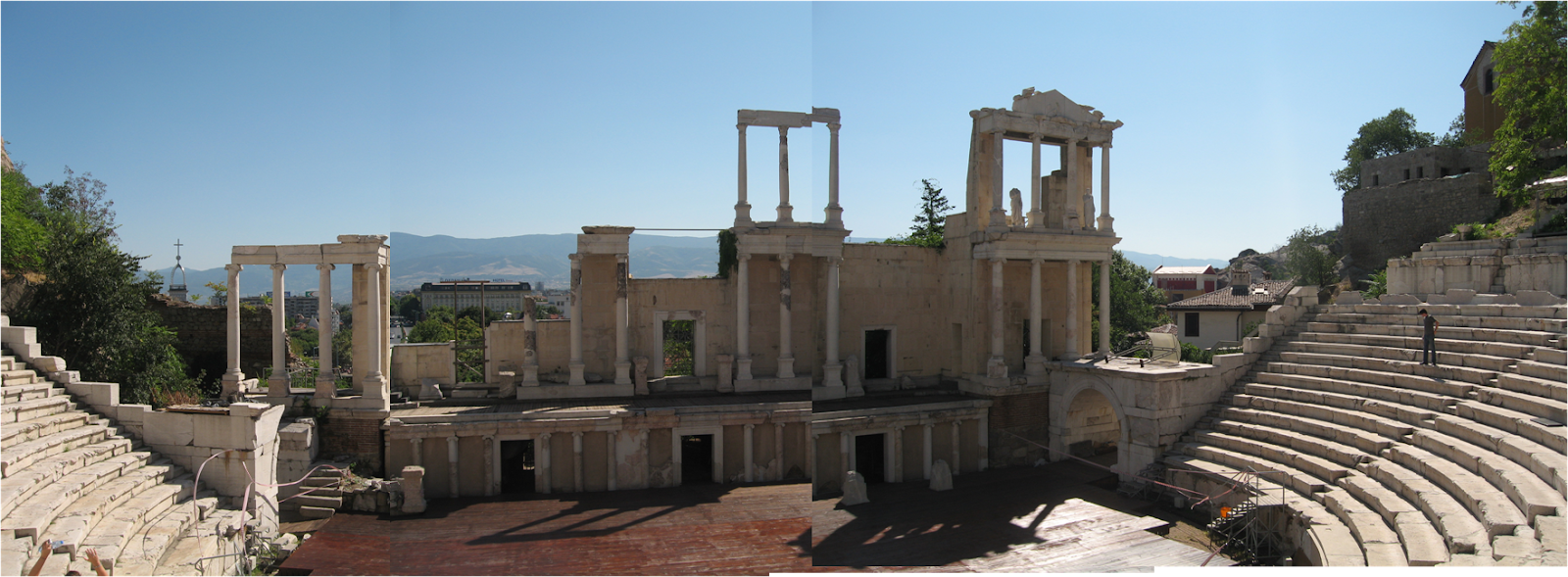
After our education on the Thracians, we continued on to Bulgaria’s second largest city, Plovdiv.  Plovdiv is one of the oldest constantly inhabited cities in Europe.  First settled by the Thracians in 5000 BC, it was then ruled by Romans, Bulgarians, Turks, Bulgarians (again), Soviets, and finally Bulgarians.  The city is famous for its shopping and the main road is car free so you can safely access the stores without the fear of being run over.  However, we were not there for shopping (though I did buy some sunglasses since I packed my sunglasses case but neglected to actually put my sunglasses inside before I left).   We proceeded through the cramped, uneven streets to the restored Roman Amphitheatre from the 2nd century AD. 

The Amphitheatre seated 6,000 in its day and was uncovered during a freak landslide in 1972.  It was restored and is now used for concerts and other performances in Plovdiv. 

After taking in the Amphitheatre, we forged onward to one of the oldest churches in Bulgaria.  The St. Constantine and St. Helena Orthodox Church was first established in 337, although the current building dates from 1832.  The inside, like most Orthodox Churches was covered in detailed paintings and relics. 

Plovdiv is known as the city with 7 hills...big hills, so it was no surprise when we walked up another hill to the site of a Thracian Fortress dating from 5000 BC.  Not only is that cool in and of itself, but it also offers great views of the city from all sides. 


As we headed back towards the main street, we passed the Djumaya Mosque which is the oldest mosque in Europe outside of Spain.  After a briefly talking to some men sitting at a sidewalk café style table on the corner outside (neither of whom looked like the person in charge), we were admitted and told to  take as many pictures as we wanted, which is strange, since most religious buildings do not allow photographs inside.  It had very detailed paintings inside each of the vaulted ceilings as well as large, elaborate chandeleirs.  Plus, as an added bonus, the carpet felt really good on my tired feet. 

As we meandered our way towards the edge of town, we passed the city center which literally has the ruins of a Roman stadium plopped down in the middle of it. They are currently working to restore the structure, so it should be really nice in the future.  The long history that is literally everywhere you look in a country ruled by so many different groups of people, makes the simple act of walking a very educational experience. 

Lastly, we walked past the shops down the main street and boarded the van to head back to the school.  Our trip to Plovdiv, much like this blog entry, was quick and rather disjointed without any real cohesiveness or transitions, so I appologize for the random conglomeration of places and facts.