Monday, January 21, 2013

Part 57: Armor, Art, and Fountains Dec 27, 2012


Day 2 in Madrid started out with a trip to the Palacio Real (the Royal Palace).  The site the palace sits on has been in royal use since Muslim rulers in Toledo built a defensive structure known as the Royal Alcázar of Madrid there in the ninth century.  The Alcázar was updated and expanded by Spanish kings and officially became a royal palace when Madrid became Spain’s capital in the 16th century.   It was used until it burned down on Christmas Eve in 1734.  (Alas, more fire)


Four years after the fire, construction on the current royal palace started.  It is the second largest royal palace in Europe after the Louvre (hey, it wasn't always a museum).  It was finished in 1755 and King Carlos III was the first king to officially start living there in 1764.  It is designed in the Hapsburg style (big and elaborate) since Spanish rulers were all mixed in with French and Austrian ones by then.

You enter the palace by coming into the huge courtyard in the back that overlooks the Cathedral.  I chose to tour the royal rooms first.  Unfortunately, no pictures were allowed, but this website has pictures of the entire inside.  The throne room was red with lots of gold.  I also saw a room completely covered in painted porcelain.  Other rooms had amazing raised moldings all around and the royal chapel, the dome of which is visible from the outside of the palace, was amazing.   Also on display in one room is the world’s only complete Stradivarius string quintet, which I was happy to see is sometimes actually used by musicians.

From the royal rooms I toured the armory.  I expected guns, crossbows, maybe some helmets and uniforms from different time periods, but I was wrong.  The armory holds hundreds of suits of armor.  Two floors of it.  Some armor comes from the 1400’s and the collection includes tournament pieces made for Charles V and Philip II and full battle armor made for Charles V.  There were children-sized suits and even suits made for women, which try as I might, I could not really find additional information on. 

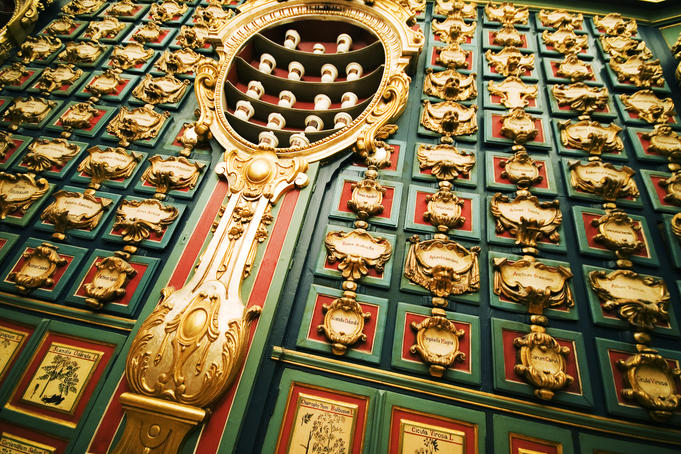
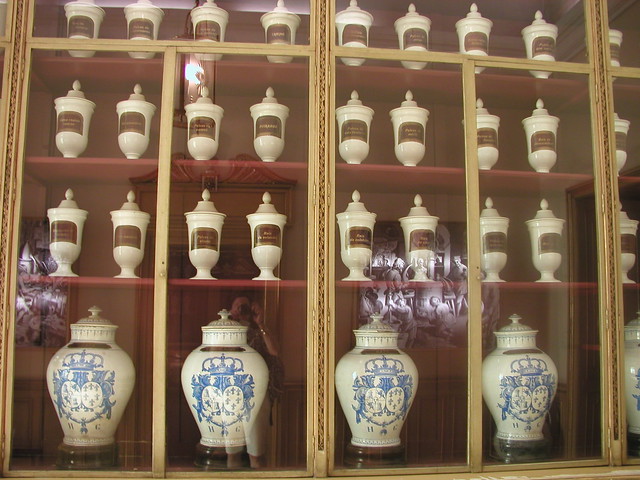
The last part of the palace tour is the pharmacy.  It was amazing.  I wanted to break the no photo rule so badly!   Philip II started the royal pharmacy to supply medicine to the royal family.  This tradition continues today and the museum even holds portraits of all the royal pharmacists.  The pharmacy has painted drawers and pottery all labeled with different ingredients.  It was really cool. 

After the palace, I stopped for lunch before catching the metro over to the Reina Sofia Art Museum.  This museum was founded in 1992 by the current king and queen of Spain and is one of the most important modern art museums in the world.  I really do like some modern art.  I really hate others (see the top left picture: Great White by Gerardo Rueda, which is a picture I’m pretty sure anyone who has laid tile has recreated multiple times).  Overall, I really enjoyed this museum.  The most famous piece I saw was Guernica by Picasso, which he made to illustrate the horrors of the Spanish Civil War.  I also saw a few pieces by Dali, one of my favorite artists (along with Grant Wood.  I have weird diverse taste).  Additionally, I really liked the evil Snuffleupagus painting ,The Four Dictators, and anything done in black and white.   I also saw a film that shows a tree blowing in the wind and the only audio is a voice saying “tree” over and over again.  It was… different. 


From the Reina Sofia, I went to the Prado Musuem.  The Prado had free entry from 6-8 pm.  If you really want to look around, you’ll need more time than that.  The Prado has one of the greatest collections of paintings in the world and it is a large collection:   according to Wikipedia, they have 7,600 paintings, 1,000 sculptures, 4,800 prints and 8,200 drawings.   Only a fraction of these are ever on display due to lack of space. 

I was fine with free admission and limited time, so I joined the line to go in.  I decided to focus on the masterpieces listed in the museum map.  I really liked Descent from the Cross by Van Der Weyden.  It almost looks 3-D when you’re standing in front of it.  The Triumph of Death by Brueghel was creepy and full of symbols.  My favorite non-masterpieces were The Archduke Leopold Wilhelm in His Art Gallery at Brussels  and The Sciences and the Arts.  For some reason, I really like paintings that show other paintings in them. 

After the Prado closed, I walked up Paseo Del Prado towards Fuente de Neptuno, an amazing fountain dating from 1786.  Farther up the street, I encountered Cibeles Square.  This square includes the Fuente De Cibeles and the amazing Cibeles Palace.  This palace was actually built in 1909 as the headquarters of the postal service.  Now it is Madrid’s city hall.  Also located there is the Bank of Spain.  The most interesting thing I learned about this building is that before the invention of modern security systems, the gold storage room in the basement would be flooded with water from the fountain in case of danger. 

I then turned and walked down Gran Via, the main fancy shopping street.  It has many tall and impressive buildings and I was stared at for probably 10 minutes by the adorable baby I was following down the street.  He was really cute and his dad thought it was really funny how intently he was focused on me.  But then, I always have been a big hit with the under 1 crowd.   

To end the day, I grabbed a Starbucks turkey sandwich (ok, so I don't really travel for the food) and headed back to the hostel to eat and talk to my friends from the night before about their Madrid experiences.   

Saturday, January 19, 2013

Part 56: ¡Hola, Madrid! Dec 26, 2012

I have wanted to go to Spain ever since I did a project on Cataluña in 11th grade Spanish.  Ten years later, I was off!  I called a taxi at 5 am and it didn’t come.  So I recalled a taxi at 5:20 am and ended up with a wet spot on my bum from the leaky water bottle the driver had in the seat before I sat down.  I hoped this was not a sign of things to come, and luckily, there were no other complications. 

I got to Madrid and dropped my bag off at my hostel and headed out to see the sights.  I was there just in time to see the changing of the guard at the royal palace.  Apparently, if you are lucky enough to be there on the first Wednesday of the month this little show involves 400 guards and 100 horses.  However, I was there on the last Wednesday of December and only witnessed the scaled down 27 guards, 6 horses version.  Still, they had a fife. 


From there, I walked up the road to Plaza Mayor, Madrid’s most famous square.  The design of the Plaza was ordered by King Philip II in 1576.  It was more in the suburbs of Madrid at that time and was supposed to replace an old market.  However, it wasn’t actually built until 1617 by Philip III.  After a few fires (per the usual), the current look is from 1790.  The Plaza has served as a market, a bull fighting ring, and an Inquisition execution site.   A few days later I took a free walking tour where the guide described the butcher shop as being right next to the executioner’s block.  Lovely. 

I headed down Calle Mayor towards Puerta Del Sol.  This plaza is on the “must see” lists for Madrid, but I wasn’t that impressed.  It is certainly busy, and it has the famous bear and tree statue, but mostly, I found it to be crowded and not that spectacular.  It was originally the site of the Sun Gate through Madrid’s old city walls, which is what its name is derived from.  Now it has the zero kilometer point for measurement on Spain’s roads and the President of Madrid’s office, which, in spite of it not being an office for the country’s government, is still the most popular spot for political protests to take place.  It is also the place to celebrate New Year’s Eve while you eat your 12 grapes. 


I moved on through the streets of Madrid, passing a Dunkin’ Coffee (which is apparently how Dunkin’ Donuts has branded itself in Europe.  It doesn’t even make sense.  You can’t dunk coffee.  You can dunk donuts into coffee.  Plus, it’s not like they don’t sell donuts) and several old buildings before winding my way back toward Plaza Mayor and the Mercado de San Miguel.  The Mercado is housed in a unique glass and iron building from 1916, however the inside is newly redone and full of food.  Lots of food.  Desserts, dried fruit, fresh fruit, chocolate, empanadas, paella, freshly made potato chips, fish, and other tapas.  I ate my way through there two days in a row for lunch. 

I then walked down towards the Santa María la Real de La Almudena cathedral.  It was originally planned in the Gothic revival architecture style and construction began in 1870.  However, construction stopped during the Spanish Civil War and did not pick back up again until 1950 when plans were revised for a baroque exterior to match the nearby royal palace.  It was completed in 1993 and the inside is very modern.   

The next thing on the list was a visit to a 2,000 year old Egyptian Temple.   The Temple Debod was a gift from the Egyptian government to Spain as a way of saying ‘thank you’ for Spain’s help in rescuing the Temples of Nubia from being flooded by a dam project in the 1960’s.  I got to the park and discovered that the temple is free to visit, but didn’t open for another hour so I decided to visit the nearby train station to buy my overnight train ticket to Barcelona that I could not reserve online. 


Have you ever been trying to walk somewhere and you can see the building, but you can’t find the door?  That is how I felt while trying to find the front of the Principe Pio train station.  I could have hit it with a rock, but there was a giant wall and then a construction site blocking my way.  I finally got inside and went to the Renfe office, only to discover the guy didn’t speak English and apparently wasn’t interested in listening to my Spanish, even though I’m pretty sure he knew exactly what I said.  Some people. 

A man that was actually helpful but worked in a different part of the station told me Senor. Unhelpful would be replaced by someone else in about 30 minutes, so I walked over to visit the giant Campo del Moro Gardens.  The park is so named because in 1109 Ali Ben Yusuf supposedly made camp here while trying to recapture Madrid and Alcazar Fortress from the Christian powers.  It was opened to the public in 1978 and offers a great view of the royal palace on the hill. 

I went back to the train station and finally got my ticket from a very nice employee with enough English to fill in the gaps in my Spanish.  I then headed back up the hill to the temple and waited in line to get in.  Inside I saw hieroglyphics and carvings and a museum about how the temples of Nubia were saved by a joint effort between UNESCO and several countries. 

From there, I walked down the road to the Basilica of San Francisco el Grande.  I really only visited this church because it was getting late and it was one of the only things still open, but I’m so glad I went.  I’ve been in a lot of churches over the last year or so.  It’s just part of what you do in Europe.  Most of them blend together and don’t really stand out in my mind.  This one, however, was a jaw dropper. 


It was built in 1760 by King Carlos III and is amazing due to the round sanctuary complete with a dome that is 108 feet in diameter (larger than the dome in St. Paul’s in London, according to the internet).  What makes this dome so amazing though is that it covers the entire seating area and it is low to the ground.  In most churches the dome is so far above you that 108 feet across doesn’t look that big.  However, if it starts about 3 stories up, it looks really big.  Plus, it’s painted with bright colors and lined with gold leaf.  It is honestly one of the most beautiful churches I’ve ever visited.  The chapels around the edges also have amazing paintings, one by Goya, and house the remains of lots of historically famous dead people. 

After I left, I walked up back up the road towards Plaza Mayor.  I popped into another church just long enough to look at the amazing wood carvings on all the walls before completing my trip back to the Plaza to take a picture of it at night.  After that I headed back to my hostel to sleep, but ended up playing beer pong with people from India, Brazil, China, Mexico, and Venezuela, all of whom were nice enough to not make me drink the beer myself since I hate the way it tastes. 

Wednesday, December 5, 2012

Part 55: I like to be in America, Okay by me in America Nov 21-25, 2012


I went home for Thanksgiving this year.  This is not the ideal break for a trip that takes 19 hours to complete just to say “hi” to the family, but previous plans fell through and I had a ticket, so Wednesday after my classes were finished, I was off to the Sofia Airport with a giant suitcase of things to leave at home. 

It was not a bad trip over.  I should buy the girl at the Lufthansa check-in desk a present for seating me by open seats for the entire trip.  I didn’t have anyone next to me on my flight to Frankfurt or DC or St. Louis.  It was awesome and since I could put my feet in the open seat, they didn’t swell up like an 80 year old diabetic woman’s.  On the downside, I had to go through security at Every. Single. Airport.  By my third time around, I was just in a daze. 

Highlights of my flights:  I had the happiest flight attendant ever on my Frankfurt flight who called all females “My lady.”  The flight attendant on my flight to DC called Canada “Ca-nay-dee-a” (whoops) before quickly pronouncing it correctly during an announcement. 

I was picked up in St. Louis by my friend SQ.  We tried to find non-fast food, but it was after midnight, so McDonald’s won out.  I stayed at his apartment for the night and ran the next morning.  While running I figured out that Starbucks was the only thing open on Thanksgiving morning so we went there for breakfast (mmmm, bagel) and got back just in time for my dad to pick me up.

My parents finally replaced Dimples, their 2003 Honda Accord with 183,000 miles on it and severe hail damage (hence the name), with a brand new Accord that is beautiful and has amazing super-computing skills.  I still not sure I know the full capabilities of this thing. 

4 hours later, we were in Kansas City for Thanksgiving at my aunt’s house.  I snacked on good salsa (you can buy Old El Paso salsa in the store in Bulgaria, but trust me when I say it is not the same.  Nor is it very good) before sitting down to HONEY BAKED HAM!!  Best ham ever.  I love that store.  It was delicious.  Unfortunately, my sister had to work the Plaza Lighting Ceremony all day, so she missed dinner and didn’t get to come over until much later, however, she still got ham. 

It was my birthday on Sunday, so I also got to open presents on Thanksgiving.  My parents got me 2 new tires for my car and my cousin and aunt got me a Clarisonic because it “changed my cousin’s life,” and she felt I needed one.  I have to say, the old face is feeling pretty good lately, so I’m inclined to agree. 

The next day, my sister and I went to Target (I could write an ode to Target, but I’ll keep it in check) and I got some new running clothes before heading to Von Marr to check out the shoe clearance section.  All shoes in Europe are really narrow and pinch my toes, so I got some new black shoes that are super comfy (and were 75% off) and some rainbow shoes that are really cute.

We then met my mom, aunt, and cousin at the mall where I got to eat Japanese Pan Noodles at Noodles and Company.  (I’m holding in another ode here)  I love that place. 

After that, my mom and I stopped at my sister’s to get my stuff before driving to the lake, where my parents have been storing my car.  We stayed the night there before hopping back in the car to drive to Fort Madison. 

After getting to FM, I went to see JF and family.  Her daughter is so big and so cute!  We all watched ‘Brave’ together before I left to eat at Amigo’s, my most favoritist Mexican restaurant ever.  It was just as good as I remembered. 

After dinner, I dropped in on LD, my neighbor who was home from marine biology grad school.  We have known each other for 23 years now which exceeds everyone else who isn’t family.  I learned from LD’s dad that some buildings near their family’s business burned down (and I do mean down) the night before.  They were worried that it might spread to their store, but luckily it didn’t.  There have been a suspicious number of fires in Fort Madison lately, leading some to speculate that it’s due to arson.  This is probably something that no one in the town ever thought would happen.   

The next morning, my parents and I went to church, then out for Chinese food (it seems like food was a major theme for this trip) before my dad drove me back to St. Louis to catch my planes home.  While in the airport, a guy offered my dad and I a “free (something unintelligible) for the best looking couple at the airport.”  Yeah, um, that’s my dad. 

Going home, I didn’t always have an empty seat this time, but I did when it counted:  From Chicago to Munich there was no one next to me.  J 

Numerical Summary: 
  • Total restaurants eaten at:  6
  • Total hours in car:  14
  •  Total hours on planes:  24
  • Total number of cows and wide open spaces observed:  countless  (probably around 14 hours   worth)
  • Total hours of sleep:  less than required

Monday, December 3, 2012

Part 54: German Science! Nov 4, 2012


For my last day in Munich I got up early to go to the Deutsches Museum, “the world's largest museum of technology and science.”  I was really excited.  It is located on an island in the Isar River and the building was originally used as barracks for workers that transported wood down the river.  It was donated to the  museum in 1903. 

Overall, I was sort of disappointed in the museum.  Quantity does not mean quality.  The Museum of Science and Industry in Chicago blows this place out of the water and I even liked the Galileo Museum in Florence a lot more.  However, here are the highlights:  you can take an awesome picture of the famous Munich skyline from the window’s of the staircase;  the exhibit on photography is interesting; the recreation of Altamira cave (the Spanish cave with some of the oldest cave paintings in the world) is really cool, since almost no one is allowed to visit the actual site;  they have a fully automated miniature clay brick factory that is neat to watch; finally, the space exhibit was awesome.

The space exhibit had satellites and equipment that has actually been in space.  They also recreated the lunar rover and Mercury Capsule (it is not very big) and they had a lot of space suits from astronauts and cosmonauts.  They also had a lot of space food including dehydrated cheese sandwhiches that were about 1 inch square.  It was interesting to see so much stuff from the Russian space program.  A lot of displays had Cyrillic labels (including the food.  Хляб, anyone?).  This was my favorite part. 

After leaving the museum, I took a nice walk down the river to the English Garden.  It is one of the world’s largest public parks that was established in 1789.  On my way there, I passed by the Bavarian Parliament, which is an impressive building to say the least, and the Angel of Peace, a monument created in honor of the 25 years of peace following the Franco-German war.  Once I got to the park, I saw beautiful leaves and a nice lake.  By then I was tired, so I just caught the train to the airport. 

Now, funny story, I was at the airport 4 hours before my flight.  I read my ticket and headed to gate 29.  Turns out, I read that number wrong (it happens sometimes, I’ll tell you more about it if I ever get around to blogging about my trip to Serbia) and almost missed my flight, which was leaving from gate 39.  AAAHHH!  Brain!  Why do you do this to me?  I heard the last call for passengers to Sofia and ran to the gate and got on the bus with my heart pounding from panic.  I was soon joined by the president of the school and his wife.  They were coming home from Portugal and their previous flight had just gotten in.  At least they had a better excuse for being late than just reading their gate number wrong.  The important thing is that I made it home and since I met the president and his wife, I got a ride back to campus. 

Saturday, December 1, 2012

Part 53: Back in Munich for Palaces and Olympics November 3, 2012

On Saturday and Sunday I was on my own and I decided to do some royal residences and visit the Olympic Park.  My first stop on Saturday was the Residence Museum, but, I was there too early, so I took the extra time to visit the inside of the Theatine Church, the yellow church we’d seen a couple of days before. 


The Theatine Church was finished in 1690 and was built by the local ruling couple, Elector Ferdinand Maria and Henriette Adelaide of Savoy, as thanks for the birth of their son.  The inside is very detailed and beautiful. 

From there, I continued up the road to the Siegestor (Victory Gate), a large triumphal arch.  It was originally completed in 1852 and was dedicated to the glory of the Bavarian army.  It was destroyed during WWII and only partially reconstructed.  It now bears the inscription: "Dedicated to victory, destroyed by war, reminding of peace.” 

Having killed enough time, I headed back down to the Residence.  The Residence is the former living space of the Bavarian Monarchs, the Wittelsbachs (I love that name).  Construction began in the 1500’s and continued up through the 19th century.  It is the largest royal residence museum I have ever seen.  130 rooms are on display.  It just kept going and going and going.  Unfortunately, a lot of the palace was destroyed in WWII, but most of it has been reconstructed.  However, some parts are redone in a simplified fashion. 

I started my tour in the treasury.  The house jewels of the Wittelsbach are on display here and pieces span 1000 years from the early Middle Ages to Neoclassicism.   The oldest surviving crown of England is here.  The Palatine Crown was made around 1370 and came to Germany when Henry IV married off his daughter to a Wittelsbach.  My favorite thing was a St. George Statue from 1599.  

After the treasury, I entered the residence museum.  The first ‘room’ I came to was the Shell Grotto.  It is a covered garden area covered in shells and rock that looks like it is dripping.  It also has a statue of Mercury above the fountain.  I believe it was from the 17th century. 

From there I entered my favorite room:  the Hall of Antiquities .  This room was constructed in 1571 to hold Albert V’s antique collection.  Apparently, it is the largest Renaissance hall north of the Alps.  Another ruler turned it into a banquet hall in the 1580’s and it even served as a library.  Eventually, they added the amazing barrel vaulted ceiling, and thank goodness they did, because that was my favorite part. 

At this point my audio guide stopped working.  (I seem to have a knack for this since I have had this happen at the Hapsburg palace in Vienna this summer and at Dachau days before).  This means that all I can really tell you is that I walked through a lot (and I do mean a lot) of beautiful rooms.  I saw amazing beds and wall coverings.  I also saw a lot of beautifully painted ceilings. 

Eventually I made it to the private chapel from the 1800’s.  It was so beautiful.  It had a blue (so of course I liked it) ceiling with gold molding over the top and granite murals on the walls.  From there, I got to see some ruler’s collection of holy relics.  Holy creepy relics.  Mummified hands, full arm bones, and skulls in ornately embroidered holders.  (Holders isn’t the right word, but moving on)  It was like a bone anatomy lesson. 

Finally, I ended up in the Baroque Ancestral Gallery.  It is a long gallery filled with portraits of Wittelsbach rulers and a nice family tree.  It also has a lot of gold.  And so, 130 rooms later, I was finally ready to move on to my next destination:  Nymphenburg Palace. 

Nymphenburg was the summer residence of the Wittelsbachs.  It was started in 1664 and added to for over 100 years.  Only a small portion of the rooms are open to the public because, interestingly, it is still home to the head of the house of Wittelsbach, Franz, Duke of Bavaria.  Even though Germany does not recognize royal titles, this problem is circumvented by making the title an actual legal surname.  This is also the man that some people feel is the correct heir to the throne of the United Kingdom. 

To get to Nymphenburg requires the use of tram 17.  Once I figured out which of the several tram stops in front of the train station 17 actually stopped at, it was an easy ride out to the palace.  I got off and started walking towards a monstrous complex.  It is huge!  It has a lake in front of it and the front of the building is 700 meters long.  The complex continues around with the stables and other buildings. 

I went inside and bought my ticket to see the rooms.  The first room was amazing.  The Steinerner Saal (Stone Hall) in the central pavilion is covered with murals.  It is 3 floors tall with an overlooking balcony and amazing chandeliers.  It was one of the most impressive rooms of the trip and considering, I visited a castle and another palace, that’s saying something. 

From the  Stone Hall, you enter some smaller chamber rooms and bedrooms, including the room where King Ludwig was born.  Eventually you get to the Gallery of Beauties.  One of the kings (I don’t remember which), commissioned 36 portraits of women from all social classes that demonstrated the different characteristics of what was considered most beautiful at the time.  I only found a couple of them to be great beauties.  Apparently the standards have changed. 

After seeing the little bit of the palace that was open to visitors, I went through the stables.  This was incredible.  There were huge coaches, small coaches, baby coaches, sleighs, a hearse, paintings of King Ludwig’s favorite horses, a taxidermy horse that was one of Ludwig’s favorites (my dad used to joke about getting the family dog stuffed after she died and setting her on the end of the couch forever, but he didn’t actually do it), and many sets of tack. 

From there, I checked out the backyard, or the gigantic park with rivers and lakes and fountains and 5 pavilions.  I only saw 2 pavilions:  The Apollotemple, which is an incredibly picturesque ancient-greece inspired building  and the Pagodenburg, a building where “the lords and ladies rest after the exertions of a round of "Mailspiel” (which is literally translated “mail game.”  I have no idea what it is).  I didn’t go inside, but the Nymphenburg website has some to look at, and they are nice. 

From there, I went to the Olympic Park.  If you go to Munich, there is a metro stop with a the word “Olympic” in the name that is NOT the Olympic Park.  That would have me some time in getting there.  Munich, of course, was the site of the 1972 Summer Olympics and the park still looks great. 

Since the sun was setting, I decided to go up the Olympiaturm.  This tower is 200 m high and you can see all the way to the Alps in the distance.  I also got to see the Olympic Stadium with its sweeping glass roof and the Olympic Village, where the Israeli athletes were taken hostage.  I also saw “BULGARIA” written on the tower in huge letters.  Apparently, I was not the first visitor to come to the tower via Sofia International Airport. 

From there I walked around the park.  I poked my head into the swimming hall where Mike Spitz won his world-record 7 gold medals at one games.  I also walked by a section of sidewalk that channels Grauman's Chinese Theatre with its celebrity handprints and signatures.  I then climbed a giant hill to over look the park as it lit up.  Finally, I hopped back on the metro and headed back to my hotel, stopping for a Subway sandwich on my way.

Sunday, November 11, 2012

Part 52: Neuschwanstein: You’ll Want to Be a Princess November 2, 2012

On Friday, we got up and caught the train out of Munich to the town of Fussen because we were visiting King Ludwig II’s fairy tale castle:   Neuschwanstein.  On an excitement scale of 1-10, I was at about a 50.  My dad visited this castle years ago and took a picture of it which was then framed and hung up at the bottom of the stairs in our house.  I saw this place almost every day of my life growing up and I was finally going there! 

The train ride to Fussen was beautiful, especially as the Alps began to come into view.  Once in Fussen, we followed a tour guide (a safe bet, most of the time) to find the busses that would take us to the small village of Hohenschwangau.  

Hohenschwangau has not one, but two castles in its sights.  The first is Schloss Hohenschwangau.  This castle was the childhood residence of King Ludwig II.  It was built by his father, King Maximilian II in 1837 and was used as the summer hunting residence for him and his family.  Ludwig turned out to be quite the outdoorsy type and once his father died, he lived in this castle permanently until his own castle, Neuschwanstein (located just a couple of mountains over), was livable.

Unfortunately, we didn’t get to Hohenschwangau early enough to go through the smaller castle, but we did visit the gardens and take in the view of the nearby lake, Alpsee.  We then began walking over to Neuschwanstein, which only takes about 35 minutes. 

As we trekked up the mountain road, my excitement was building.  I was also hot.  I was the only person I saw carrying my coat up the mountain rather than wearing it.  In my defense I was wearing a really warm sweater underneath. 

We reached the top and got our first look at the front of the castle and it was amazing!  It’s exactly what everyone pictures in their heads when you say, “castle:”  Big and white with lots of turrets.  King Ludwig was a fan of “castle romanticism.”  He wanted a castle that stood as a monument to medieval culture and kingship.  In other words, he liked the style for the same reason we do:  It’s a romantic reminder of the past. 

Construction began in 1869 and ended when King Ludwig died in 1892.  The castle was (and still is) unfinished.  However, the finished parts are amazing.  I was a little worried that the inside would be disappointing compared to the outside… but it wasn’t.  Ludwig loved the operas of Richard Wagner (dum dum did e dum dum, dum did e dum dum…) and he designed the inside of the castle to showcase several different operas including Lohengrin, Tannhauser, Tristan and Isolde, Der Ring des Nibelegen, and the Grail King (sorry, the brochure I picked up only lists them in German, and I don’t feel like translating them).  No pictures are allowed inside, but click this link for what I saw. 

It was spectacular and now I want to live there. 

Before our tour of the inside, we ran (quickly walked) to Marienbrucke (Marie's Bridge) to take some pictures.  The sign said it would take 30 minutes to walk there.  Maybe if you have 6 toddlers hanging on your arms.  We were there in 8.  We were in a hurry though, since our tour was starting soon, so we did leave the average person in the dust. 

Marienbrucke was built in 1866 by King Ludwig over a gorge overlooking the castle.  In spite of the fact that it is 90 meters in the air, I was so excited, I didn’t even care.  We took our pictures and were back in plenty of time for our castle tour. 

Sadly, King Ludwig never got to finish his castle.  He pretty much bankrupted Bavaria with all his spending on it and in 1886, he was declared insane.  Although his brother Otto was insane, Ludwig probably was not.  It was just a convenient way to get rid of him without a lot of questions.  Shortly after being removed as King (and removed from his castle), Ludwig and the doctor he was with were found dead in Lake Starnberg (a few hours away from Neuschwanstein)  in waist-high water.  The doctor apparently had injuries to his head and shoulders, which makes the deaths look incredibly suspicious.  Ironically, Bavaria is now the richest state in Germany, partially due to Ludwig’s castle and patronism of the arts. 

After our tour, we walked back down the hill, caught the bus back to Fussen and the 6:05 train to Munich.  We ate some McDonalds for dinner and EL and SG were off to Bad Tolz for some hiking.  I didn’t join them because I tweaked my knee on the stairs the week before and didn’t see a lot of downhill trekking as the best thing for it.  So, they were off and I was on my own for the next two days in Munich. 

Saturday, November 10, 2012

Part 51: Munich: Sausage and Beer October 31- November 1, 2012

Right after school on Wednesday, EL, SG, and I were off to the airport to spend our 4 day weekend in Munich, Germany.  After arriving and finding our accommodations we headed off to meet two of our friends for dinner at the Hofbräuhaus. 

Hofbräuhaus is the most famous beer hall in Munich.   It was founded in 1589 by a Duke of Bavaria and it has been in the same location (although I think it burned down a couple of times) since 1688.  It can hold 2500 people in the main hall and although it is a major tourist spot, some locals have permanently reserved beer steins and tables.  The food is traditional Bavarian fare.  In other words, they serve a lot of sausage.  I normally eat a hot dog about once a year and consider my yearly sausage intake to be met, but in the spirit of being in Germany, I got a bratwurst on sauerkraut.  A lot of sauerkraut.  We also had delicious pretzels and my friends all got liters of beer.  I eventually started falling asleep, so we walked back across the sticky floor towards the exit, stopping to take pictures of the amazing ceiling. 

The next day we woke up and headed to the city centre.  We were going to go to the tourist information center for a map, but we forgot that November 1 is a holiday in catholic countries.  Since everything was closed for All Saints Day, we checked out some local churches as the bells signaling the start of mass peeled. 

We first ducked into Frauenkirche (The Church of Our Lady).  The church was completed in 1488 but took a major hit during WWII (like most of the rest of Munich).  Luckily, they worked really hard on rebuilding and restoring it to its original condition.  The last restoration was only completed in 1994- 50 years after it was hit.  The outside of the church has two towers with very distinct onion-shaped domes.  I read that there were supposed to be Gothic style  towers (in other words, the towers were supposed to be pointy), but they ran out of money so they put domes on them instead. 

Inside the church was big and bright and very simply decorated but massive.  We got there right as mass was beginning so we couldn’t take pictures, however, I secretely recorded the start of the sung mass that was going on by appearing to really intently study the tomb of Emperor Ludwig IV of Bavaria.  The song was beautiful. 

From there, we walked towards the main theatre and the Royal Residence.  The Royal Residence’s entire front is under restoration, of course.  We took pictures anyway and continued walking up the street past Theatinerkirche, giant yellow domed church.  The inside was extrememly ornate, but we couldn’t take pictures because mass was still going on. 

We stopped at Starbucks on our was back to Marienplatz to watch the Neues Rathaus Glockenspiel.  The New Town Hall (Neues Rathaus) is literally 1 block away from the Old Town Hall and was finished in 1874.  The building is a Gothic Revival architectural marvel, but that’s not the reason hundreds of tourists (including my friends and me) were there at 11 am.  We were there to watch the Glockenspiel. 

The Glockenspiel was added to the tower in 1908 and its 43 bells and 32 life-sized figures tell two stories.  On the top level, the story of the Duke Wilhelm V’s marriage to Renata of Lorraine is shown, complete with jousting knights.  I only recorded the knights first time around (when nothing happens) and unfortunately did not catch the Bavarian knight winning on the second go round. 

The bottom half is the Schäfflertanz (the coopers' dance).   In 1517 the plague came to Munich.  Supposedly the coopers danced through the streets to “bring fresh vitality to fearful dispositions.”  Their dance showed loyalty to the duke in difficult times and apparently this dance is performed by actual people in Munich every 7 years ever since (talk about long-standing traditions). 

After the Glockenspiel finished, we were off to visit Dachau Concentration Camp.  While Auschwitz-Birkenau’s 1.1 million murders far outnumber Dachau’s 32,000 deaths, Dachau is important because it was the first Nazi concentration camp to ever be opened.  It opened in 1933 as a prison camp for political prisoners and wasn’t liberated by American Troops until 1945. 

Dachau was the model for all camps that followed it and it also served as the training facility for the SS Death Squad- the guards at all other camps.   After 1938, all types of prisoners were detained here, over 200,000 in all.  Along with the horrible treatment, many deaths were caused by a massive typhus outbreak in 1945 and death marches that took to and from Dachau at the end of the war increased deaths even more. 

As you approach the entrance to the camp you can still see the train platform and railroad tracks were trains full of people used to arrive.  The iron gate has been reconstructed to look just like the original with the words “work makes you free” written on the top.  After passing through the gate, you can see the main camp yard, 2 reconstructed barracks and the maintenance building.  We started by walking back towards the bunker. 

The bunker is not actually a bunker but a prison for “special prisoners.”  There were several Catholic priests that were held here, a British Intelligence agent, and George Elser- the man who tried to assassinate Hitler using a bomb in 1939.  The  bunker was the place you did not want to be sent.  Many murders took place in the bunker (by guards and other prisoners) and the practice of pole-hanging (putting people’s hands behind their backs and then hanging them from a pole by their wrists) was common torture technique. 

From there, I went through the main memorial in front of the maintenance building.  It goes down into a depression to represent the oppression experienced there and then comes out on the other side by a memorial holding the ashes of an unknown prisoner and a wall saying “Never Again” in several languages.  Above the center of the memorial is a sculpture representing the electric barbed wire of the fences and prisoners committing suicide by throwing themselves into it, which was a common occurrence due to the horrible conditions of the camp.  There is also a sculpture showing the different colored triangles that the Nazis used to label people at the camp.

From the memorial, I visited the reconstructed portion of fence before going to the museum in the Maintenance building to see the museum film.  The Maintenance building originally served many functions for the camp.  It housed the kitchens (not that they really fed the prisoners), laundry (again, not really used for the prisoners), the bath houses, and some offices.  Now, the maintenance building houses a great museum with a lot of really interesting information that I won’t write about here because this post is already getting long.

From the maintenance building I went through the reconstructed barracks.  There were originally 20 barracks that were designed to hold 250 people, but at the time of liberation 1600 people were in each.  I then walked past the concrete foundations of the original barracks, one of which housed the brothel.  Women prisoners from other camps were put into this brothel and a visit there was a reward for hard work.  Just when you think it can’t get worse. 

At the back of the camp are several religious memorials.  One is a Catholic chapel, since over 3,000 Catholic priests and bishops were in the camp.  Next to it, of course, is the Jewish memorial.  On the opposite side is the protestant chapel memorial and across the bridge to the crematorium is the Russian Orthodox chapel memorial.  All major persecuted groups’ religions are present.  At the back, under the guard tower is an entrance to the Carmelite Convent.  It is a working convent of nuns who feel it is their duty to pray about what went on at the camp and the prisoners that were there.

After visiting the memorials, I walked over to the crematorium.  Since so many people were dying in this camp, they actually had to build a second, larger crematorium to keep up with all the bodies.  It was very difficult seeing these furnaces.  You always see pictures of them in history classes, but seeing them in real life makes the true horror of all of it very real.  I stood in a room where they used to pile hundreds of bodies up before they were burnt.  Ugh, awful.

Dachau also had a gas chamber, though it was never used for mass extermination.  Still, to see the fake shower heads and the drawers where pellets that let off Zyklon B gas were put was surreal.  All around the crematorium are mass graves and sites where ashes are buried.  There is also a memorial statue showing a prisoner.  The words were in German, so I don’t know what it said, but the statue itself was a powerful image. 

I don’t know that I would call my trip to Dachau fun, because it wasn’t.  However, it was interesting and important.  People were responsible for this horrifying portion of history and only people can stop it from happening again. 

On the train back to Munich we met a man who was a physics teacher, but he quit his job to take a 3 month trip to Europe.  I wish I didn't have major bills to pay and could just travel around.... sigh. 

That night we ate at Augustina, another beer hall with German food.  I ate some delicious lentil-sausage-potato pasta thing, and although I liked it, I am not eating anymore sausage for the next year.